Choosing the right product strategy framework is very important for every product manager. We will go over some top models like Kano, OKR, Hooked, etc. The same frameworks apply when you're shaping an AI product roadmap, though the inputs change in ways that catch first-time AI PMs off guard.
Remember, choosing the right product strategy will go a long way in making sure that the entire product life cycle proceeds flawlessly.

To put it more bluntly, many product managers do not spend sufficient time in choosing the right strategy.
Learn the top skills of product management.
The wrong strategy can result in the failure of a product. After all, no product manager wants their product to show up in the list of the top product fails of all time.
The product manager is the one who takes the decision on which framework to use. And not the project manager or even the product owner.
Now would be a good time to make sure the following differences are clear -
Sometimes, the chosen strategy changes from project to project.
Like everything else in the world of agile methodology, we need to be agile while choosing our frameworks.
Product Strategy Frameworks
We will be going over the following top product strategy frameworks.
When choosing a product management course/certification, try to make sure that the course covers the prominent product strategy models.
- Kano Model
- MoSCoW Method
- OKR Framework
- Nir Eyal Hooked Model
And of course, there are many more models available out there.
I have chosen to focus only on these models as I have seen these to be the most commonly used.
If you feel I should include any other model as well, do let me know!
Let us now cover each product strategy framework in detail.
Kano Model
The Kano Model is probably the most well known product strategy framework out there.
The name comes from its creator, Noriaki Kano.
The basic concept of the Kano Model is simple. The model looks at feature implementation vs user satisfaction. If the user satisfaction is high, then the feature becomes a 'Delighter'. If the user user satisfaction is low, then the feature becomes a 'Basic Need'.
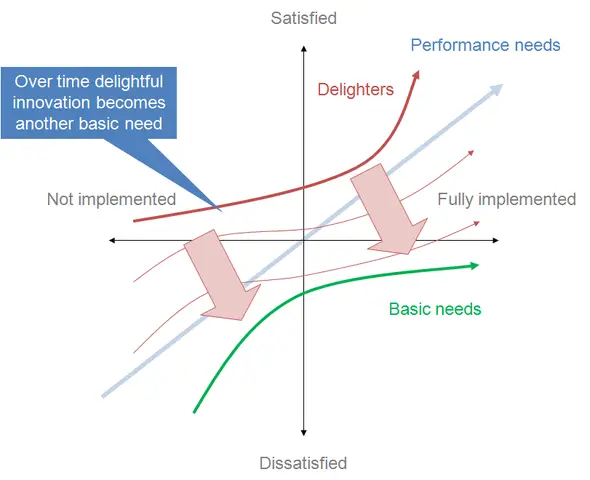
Diagram by Craigwbrown (resized) · CC BY-SA 3.0 · Source

An important point to note here is that over time, delighters become basic needs.
For example, the first iPhone was launched with only one button on the front, the Home button. There was no other button on the front. It was entirely a touch screen smartphone.
Many people were delighted by this innovation from Apple.
Remember, we are talking about the 2007. Yes, the first iPhone was launched that long ago!
However, every single company copied that design.
Slowly, that delightful feature became a regular feature. It became a "basic need".
Very quickly, people started expecting this great innovation as the minimum benchmark for a smartphone.
Therefore, constant innovation is a must to churn out new delighters with every product launch.
MoSCoW Method
The MoSCoW acronym stands for the following feature classifications.
- Must Have Features
- Should Have Features
- Could Have Features
- Won't Have Features
The feature prioritization is essential in every product document, be it the business requirement document, the product roadmap or the product backlog.
The most common product and project management tools have easy customizations to accommodate the MoSCoW framework.
Check out this free Jira tutorial.
There are drawbacks to this feature, including the lack of granular level priority and the lack of the concept of deadlines or time lines.
OKR Framework
Check out the complete guide on Google's OKR Framework.
OKR stands for Objectives, Key Results. It is a very popular framework amongst beginner product managers.
It may sound like a simple product approach, but that's the beauty of this model.


A strategy does not need to be overly complex or complicated for it to be 'right'.
Sometimes, the simplest approaches work the best.
If OKR works for Google, there is a good chance that it will work for you too.
Again, this model's simplicity allows it to be easily used in any product or project management tool.
Also, check out the top differences between Asana and Trello.
Nir Eyal Hooked Model
The concept of Nir Eyal's Hooked Model is to introduce 'hooks' into your product that will make the user keep coming back to the product.
Nir Eyal's classic book 'Hooked' is a must read for every single product manager.
The key here is to introduce 'habit forming' features.
This is personally my favorite model.
However, this is not a simple model.
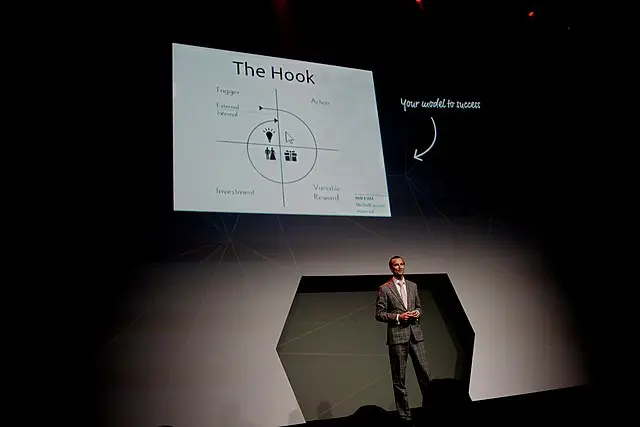
Photo by Franklin Heijnen (resized) · CC BY-SA 2.0 · Source
.jpg)
How does a product manager figure out which features can be 'hooks'? Well, that's part of the roles and responsibilities of a product manager!
Apps like TikTok also use the concept of a tension build-up and then a tension release.
For example, a new user on TikTok is given a boost with likes on their videos. Over time, the likes or other engagement reduces.
This is the part where the 'tension' builds up.
Then, the app again gives a boost to the user's videos with more likes or other engagement.
And hence, the 'tension' is released.
Remember, it is important for product managers to introduce features that make users keep on coming back to the product.
Therefore, having a hook is at the heart of any good product strategy.
However, unlike the simpler MoSCoW method, it is harder to visually depict this methodology using tools like Kanban.
Conclusion - Product Strategy Framework
Those were the top product strategy frameworks. We have gone through a brief overview of each.
Each strategy has its pros and cons.
There are still many more frameworks available out there.
As the product manager, it is ultimately your call on what framework works best for your software development life cycle.
Many product managers also feel that they don't have the 'authority' to bring about change by choosing a new model.
Nothing can be further from the truth.
Everyone, and definitely product managers, can bring about meaningful change.
Learn how to influence without authority.
Every product manager is a natural leader. Learn the top leadership qualities and team management skills.
Subscribe to my newsletter for occasional notes on product failures and shipping AI in real businesses.
I also regularly publish my thoughts on Twitter.
RELATED READING
Product Life Cycle - Definition and Examples (2026)
The product life cycle (PLC) is the series of steps through which every product goes. Product life cycle stages - Introduction, Growth, Maturity and Decline.
Product Roadmap Guide - Definition and Examples
Why are you building? What are you building? These two questions form the basis of any good product roadmap. Learn how to create the best product roadmap.
What is OKR Framework?
OKR stands for "Objectives and Key Results". To be a successful Product Manager, you need to fully understand the OKR Framework - a must know strategy.
Must Have Product Manager Skills
This is your critical Product Manager Skills List - Your Ultimate Guide to becoming a great PM. These necessary skills will ultimately define your success.
What Does A Product Manager Do - Job Description, Role & Responsibility
The Product Manager Job Description has a few things in common across companies. Essentially, the Product Manager is the CEO and the janitor of the product.
Top 12 Failed Products - Failure Examples and Best Management Lessons
As a Product Manager, we don't want our products to fail. Let us analyze some of the biggest failed products in technology to see why they failed.
The AI Roadmap for Small Business: Start to Scale
Most small business owners I talk to are stuck in the same place with AI. They've watched ChatGPT do something impressive. They've signed up for two or three SaaS products with "AI" in the name.…
FREQUENTLY ASKED
- What's the best product strategy framework?
- There isn't one. Different frameworks fit different stages and questions. Kano helps you think about feature value. OKR helps you set and track measurable goals. Jobs-to-be-Done helps you understand why customers actually hire your product. Hooked helps you design for habit. Pick the framework that matches the question you're trying to answer, not the one that's currently fashionable.
- Do I need a framework at all?
- Yes, even if it's an informal one. A framework is just a structured way of thinking about a decision. Without one, every decision gets argued from first principles, which is exhausting and inconsistent. With one, the team aligns on the rules and argues over the inputs. The argument over inputs is the useful one.
- How do I introduce a strategy framework to a team that's never used one?
- Start with one decision. Don't try to roll out the framework across the whole roadmap. Pick the next prioritization call and frame it explicitly using the framework. See what people do. After a few cycles the team will either internalize it or push back, and either response is informative.