The product life cycle (PLC) is the series of steps through which every product goes. Product life cycle stages - Introduction, Growth, Maturity and Decline.
As a Product Manager, this is what you constantly need to think about.
The lifecycle of your product is all you should ever care about. After all, nobody is more responsible for a successful lifecycle than a Product Manager.
Equally important, nobody is more responsible for a failed lifecycle than a Product Manager.
Let us now go over the definition.
Product Life Cycle Definition
The product life cycle is the path a product follows from launch to withdrawal, split into four stages: introduction, growth, maturity and decline. Sales, costs and competition behave differently at each stage, so the stage tells you what the product needs from you.
What works in the first stage may not work in the second stage.
A product rarely runs one clean curve. A big feature launch or a new market starts a mini-cycle inside the main one. Map every product you own on the same curve and you can see whether next year's revenue is covered. Track your features. Falling usage is a leading indicator, and it shows a stage change months before the P&L does.
Product Life Cycle Stages
The product life cycle has four stages, and most products move through them in this order.
-
Introduction
-
Growth
-
Maturity
-
Decline
We will cover each stage in detail.
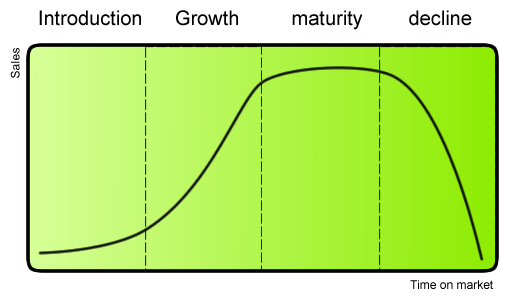
The product lifecycle consists of four stages.
Chart by Mwpnl · CC BY-SA 3.0 · Source

It is important to fully understand each stage. Eventually, you need to prepare your product for each stage.
You take weeks planning for the perfect launch, you use tools like Scrum or Kanban.
But it all comes down to your market launch.
1. Introduction Stage
The introduction stage is the launch period, when awareness is low and sales are small. Costs are at their highest because you're still paying for development, marketing and onboarding, and direct competition is usually thin.
The product life cycle introduction is where the magic begins.
This is when you launch your product. Keep it simple. Don't forget the KISS principle.
It is in the initial phase, and you are trying to get customers. It will take time to build a loyal customer base.
Betas and early adopters tell you whether the fit is real, and it's a lot cheaper to find out now than after you've hired a sales team.
Don't obsess over scale yet. Obsess over fit.
During introduction, there are various product life cycle strategies that you can start with.
I would strongly recommend Google's OKR framework.
What to watch: CAC, activation rate, early churn and NPS from the first users.
2. Growth Stage
The growth stage is when adoption accelerates and unit costs fall as volume builds. Competitors notice and start entering, so differentiation matters more than it did at launch.
You need to be really agile here.
Growth hides problems. Keep your ear to the ground, especially with the support and customer success teams.
Pay down the tech debt you took on to launch, because that infrastructure won't carry the next segment or the next channel.
Do whatever it takes to market your product.
Think like a consumer.
What to watch: MRR or ARR growth, retention cohorts, LTV:CAC and how fast new features get adopted.
3. Maturity Stage
The maturity stage is the peak of the curve, where sales flatten because most of the people who want the product already have it. Unit costs are as low as they will get, and competition is at its heaviest.
This is where great PMs shine. Sustaining is harder than launching.
Optimize ruthlessly. Every friction point in UX, pricing and onboarding is now a churn risk.
Brand, ecosystem and switching costs are the moat.
Bundles and integrations are where a mature product finds new revenue.
What to watch: net revenue retention, churn, upsell and cross-sell rates, and CSAT.
4. Decline Stage
The decline stage is when sales fall because the market has moved on to a substitute. Cost per user rises as volume falls, and competition thins out.
The best PMs know when to let go.
Sunset it or reinvent it, but decide. Gut feel usually says keep going, so make the call with a product strategy framework instead.
Automate support and cut costs while you work out whether the IP is worth selling.
Every decline is a case study for the next launch, so write down what happened.
What to watch: active users, support cost, profitability per user and how ready you are to exit.
Sometimes, people talk about "product life cycle 5 stages". When people say 5 stages, they are basically referring to a sub-part of the decline stage.
This fifth stage is basically the "refresh" stage when you bring about a new version of your existing product.
But, the more acceptable practice is to consider that refreshed product as a new product with a new lifecycle.
Product Life Cycle Video
My product life cycle video on YouTube covers the basic concepts of the PLC.
I go over all the stages and some very well known examples in this video.
https://youtu.be/ycXlbR6Za5E?t=636
Let us go over the examples now.
Product Life Cycle PPT - Product Management Life Cycle Stages
My product life cycle PPT on SlideShare is a very detailed presentation on the key concepts of the PLC.
This PPT contains examples of some well known failed products.
Check out the top 10 biggest failed products of all time.
https://www.slideshare.net/AayushJain83/product-life-cycle-with-examples-aayush-jain
The examples below are easier to follow once you've tried placing a few products yourself.
QUIZ
Which stage is it in?
Pick the stage each product is in as it stands in 2026.
Takes about three minutes
Product Life Cycle Examples (2026)
Every single product that you hear about today can neatly fit into the four-stage product lifecycle.
In fact, every single product that has been ever produced or will be ever produced must follow the product lifecycle.
Let us go over some product life cycle stages examples.
Before we talk about more examples, I want to make a special mention for Nokia.
Nokia is considered a favorite example whenever the concept of product life cycle is discussed.
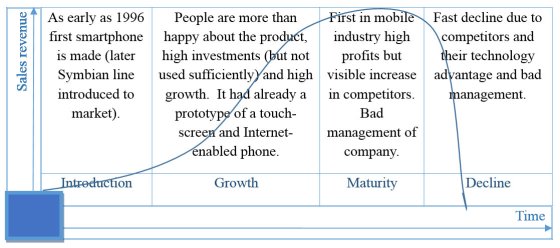
Nokia is considered a favorite example whenever the concept of product life cycle is discussed.
Diagram by Karolis123321 (resized) · CC BY-SA 3.0 · Source

Introduction Stage Examples (2026)
A product is in the introduction stage when it is on sale, or nearly on sale, but few people outside the early adopters have tried it.
These products have not yet entered the popular imagination.
You hear about them on and off. But, the majority do not take these products seriously.
-
AI glasses with a display - Meta Ray-Ban Display went on sale at a limited set of US retailers on September 30, 2025, and in September 2026 Meta announced it was expanding sales to the UK, Canada, France, Italy and Germany. Google's Android XR glasses are announced but not yet on sale.
-
AI-native browsers - Perplexity's Comet, The Browser Company's Dia and Opera Neon are all shipping to the public.
-
Brain-computer interfaces - Neuralink said in January 2026 that 21 participants were enrolled in its trials worldwide, and Precision Neuroscience has an FDA clearance for its Layer 7 cortical interface but says its brain-computer interface is investigational and not for sale in the US.
See all 12 introduction stage examples
The traits are high development and marketing cost, low sales, and a team that spends most of its time educating users and collecting feedback.
Growth Stage Examples (2026)
A product is in the growth stage when demand has outrun the early adopters and the category has proved itself.
Let us now talk about the product life cycle growth stage products.
These products were considered fringe till a few years back.
They have started to enter the popular imagination now.
When people are buying something new, these new age growth stage products are a factor. These occupy mindspace and are a viable alternative to the traditional products.
-
AI coding agents - Claude Code, Cursor, GitHub's Copilot coding agent and OpenAI's Codex are competing for the same developers, and GitHub says its agent alone created more than one million pull requests between May and September 2025.
-
Enterprise AI agents - Salesforce, Microsoft and ServiceNow all sell them now, and Salesforce said in August 2026 that Agentforce annual recurring revenue passed $1.5 billion, up more than 240% year over year.
-
GLP-1 drugs - Eli Lilly's Q2 2026 revenue rose 48% on Mounjaro and Zepbound, and two weight-loss GLP-1 pills won FDA approval within four months of each other. Novo Nordisk now guides flat to lower adjusted 2026 sales even as volumes grow, which is what competitors entering looks like.
See all 12 growth stage examples
The traits are fast sales growth, an expanding market and competitors entering.
Maturity Stage Examples (Mature Products 2026)
A product is mature when the fight is over share rather than new users, and the work shifts to retention and margin.
The maturity stage of product life cycle refers to products that almost all of us are very familiar with.
These products are fairly mature.
Expect them to decline within the next decade and give way to products that are considered new or experimental.
You may be so used to something today that you think you will use it forever.
But, history always repeats itself.
-
Smartphones - The market is saturated and, per IDC, now shrinking, with global shipments down 7.4% year over year in the second quarter of 2026.
-
Streaming - Netflix told shareholders in April 2024 that it would stop reporting quarterly membership numbers from its Q1 2025 results, and its Q1 2025 letter led with revenue and operating income instead.
-
Social networks - Meta's daily users across all its apps are still growing, but only slowly.
See all 12 maturity stage examples
The traits are slowing growth, heavy competition, and a focus on brand loyalty and cost.
How mature products extend the life cycle with AI
The textbook way to extend a mature product's life cycle is to add new value to the installed base, and in 2026 that value is AI.
Microsoft introduced Microsoft 365 Copilot in March 2023 as an AI assistant inside Word, Excel, PowerPoint, Outlook and Teams, and by July 2026 it had over 30 million paid seats.
Gemini in Gmail summarizes threads and drafts emails in the inbox you already have, and Google folded it into the Workspace Business and Enterprise plans in January 2025.
Adobe made Firefly commercially available in September 2023, along with Firefly-powered features in several Creative Cloud apps.
Zoom's revenue grew 4.4% in fiscal 2026 after 3.1% in fiscal 2025, and its own 10-K names "the maturation of our business" as one reason its growth rate has slowed and may slow further. Its answer is AI Companion, included at no additional cost for users with eligible paid Zoom services, and AI Companion 3.0 launched in December 2025 for all paid Zoom Workplace users. Zoom says it charges nothing extra because it believes those features will improve customer retention and drive revenue.
Adding AI defends the product against substitutes before they take your customers.
You get a fresh curve without building a new product.
Which AI feature to add is still a roadmap decision, and I'd score each use case the way the AI roadmap for a small business does before committing engineering to it.
Working out where AI actually fits in an existing product or operation is the question we answer in the AI Opportunity Audit.
Decline Stage Examples (2026)
A product is in the decline stage when its sales keep falling as users move to a substitute, and the clearest sign is the vendor itself announcing an end-of-support date, a shutdown or a replacement.
This is the part of the product life cycle theory that most people simply choose to ignore.
If you are a 90's kid, consider any product from that generation.
I'm sure you are already thinking of a few products here.
The decline stage products listed here are not very popular these days. Most have been replaced by something that is more user friendly and probably cheaper.
-
Google Assistant - Google says Gemini is replacing Assistant on most mobile devices in 2026, and in August 2026 it told users it would start removing Assistant from Android phones and Wear OS watches on September 3, 2026, rolling out over a few weeks.
-
Skype - Microsoft announced in February 2025 that it would retire Skype and move users to the free version of Teams, and retired it on May 5, 2025.
-
Landlines - CDC survey data released in September 2026 show that 80.0% of US adults lived in wireless-only households in the second half of 2025, and only 1.0% lived in landline-only households.
The traits are falling revenue, less marketing, and the sunset-or-reinvent decision that nobody wants to make.
Some of these decline stage products have managed to reinvent themselves and are now available in a new avatar.
By now, I am sure that you will be able to grasp the importance of product life cycle management.
Facebook and the Product Life Cycle
Facebook is the cleanest example I know of a mature product that keeps extending its life cycle.
Meta no longer breaks out Facebook on its own. The last time it reported Facebook-only figures, for December 2023, Facebook had 3.07 billion monthly active users, up 3% year over year.
Meta's apps together had 3.60 billion daily active people in June 2026, up just 3% year over year.
AI features are the latest extension.
Final Thoughts
Work out which stage your product is in before you plan the next quarter.
Follow me on Twitter for the latest updates.
Don't forget to subscribe to my newsletter for occasional notes on product failures and shipping AI in real businesses.
RELATED READING
Best Product Strategy Frameworks
Choosing the right product strategy framework is very important for every product manager. We will go over some top models like Kano, OKR, Hooked, etc. The same frameworks apply when you're shaping…
Product Roadmap Guide - Definition and Examples
Why are you building? What are you building? These two questions form the basis of any good product roadmap. Learn how to create the best product roadmap.
Top 12 Failed Products - Failure Examples and Best Management Lessons
As a Product Manager, we don't want our products to fail. Let us analyze some of the biggest failed products in technology to see why they failed.
What Does A Product Manager Do - Job Description, Role & Responsibility
The Product Manager Job Description has a few things in common across companies. Essentially, the Product Manager is the CEO and the janitor of the product.
Product Manager vs Product Owner
You will often hear the terms Product Manager and Product Owner used interchangeably. However, there is a critical difference between the two.
Efficient Product Feedback Loop - Best Customer Strategies & Latest Tools
An efficient and easy product feedback loop is an essential component of every successful product. Your target audience should know how to reach out to you.
The AI Roadmap for Small Business: Start to Scale
Most small business owners I talk to are stuck in the same place with AI. They've watched ChatGPT do something impressive. They've signed up for two or three SaaS products with "AI" in the name.…
FREQUENTLY ASKED
- What are the four product life cycle stages?
- Introduction, growth, maturity, and decline. Introduction is the high-cost low-volume launch period. AI glasses with a display are the 2026 example. Growth is when adoption accelerates and unit costs drop, like AI coding agents. Maturity is the peak where the market is saturated and competition is fierce. Smartphones are the obvious case. Decline is when usage falls and the team has to decide whether to refresh, harvest, or sunset, like Google Assistant, which Gemini is replacing on most mobile devices.
- How does a PM adjust strategy as a product moves through the life cycle?
- In introduction, focus on positioning and proving the value prop with early adopters. In growth, focus on operational scale and customer acquisition cost. In maturity, focus on margin protection, retention, and adding new value to the installed base, the way Copilot in Office and Gemini in Gmail do. In decline, focus on milking margin or planning the successor product. The same PM playbook doesn't work at every stage.
- Why do most products fail in the introduction stage?
- The product hasn't found product-market fit and the team keeps building features instead of validating demand. Failed launches usually have the same shape: too much spending on marketing before customer signal is real, or too much engineering invested before the team has talked to enough customers. The fix is to slow down on the feature side and speed up on the conversation side. The Humane AI Pin, launched in April 2024 and discontinued in February 2025, is a recent introduction-stage failure.