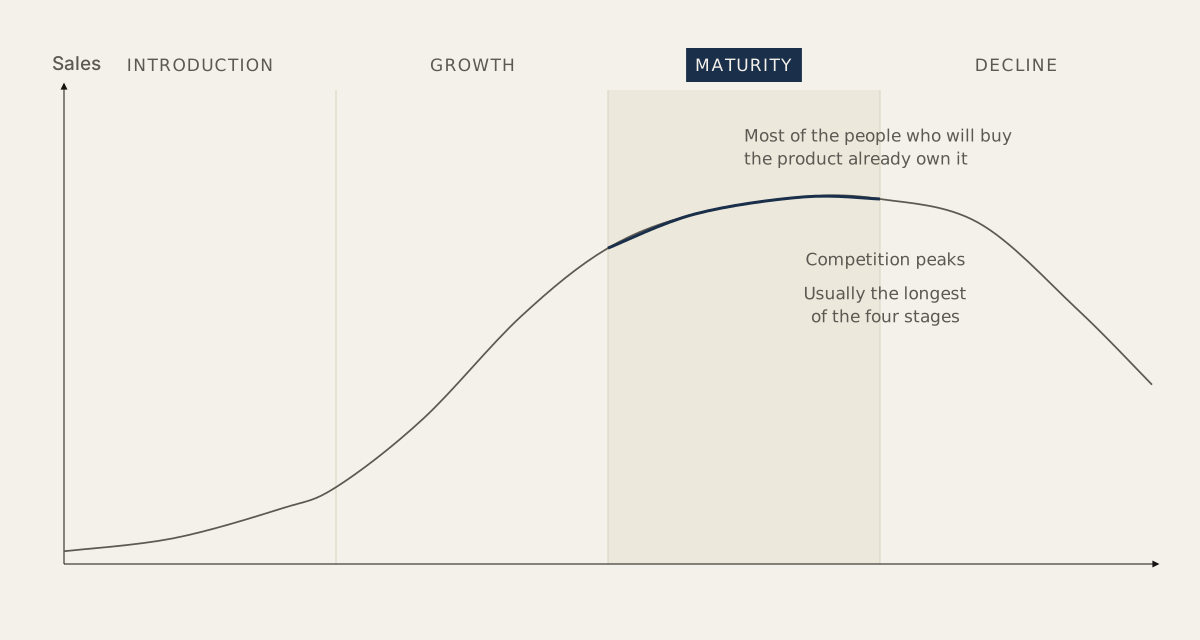
The maturity stage of the product life cycle is the period when sales growth slows or stops because most of the people who will buy the product already own it. Competition peaks, and the work shifts from finding new customers to defending share and margin with current customers.
It's usually the longest of the four product life cycle stages, and it's where most of the products you use every day sit.
An original diagram, free to reuse with a link to this page · Download the SVG
The curve as text
- At maturity, sales growth slows or stops because most of the people who will buy the product already own it.
- Competition peaks, and it is usually the longest of the four stages.
- The four stages in order: introduction, growth, maturity, decline.
The maturity stage examples below are current as of September 2026.
How to Recognize the Maturity Stage
A product is in the maturity stage when the number of buyers has stopped growing much but the company keeps finding ways to earn more from each one.
-
Sales - A company that stops reporting a user count is usually telling you the count isn't the story any more. Meta stopped reporting Facebook daily and monthly active users.
-
Competition - Share moves between a few big players, and the serious threat often comes from a substitute in another category.
-
Pricing - Price rises get tied to new features, and cheaper basic or ad-supported tiers appear for the buyers who won't pay more.
-
Marketing - Spend moves from the awareness push of the growth stage to retention and upgrades.
Revenue growth alone won't place a product. Several examples below still grow by double digits, and they're mature because of where that growth comes from.
How Strategy and the 4Ps Change in the Maturity Stage
In the maturity stage, you can find new users or new uses for the product, or change it so existing customers have a reason to pay more.
-
Product - The core changes slowly. Most new work goes into line extensions and features for current customers, like Coca-Cola Zero Sugar or Copilot inside Word.
-
Price - Don't cut the core price, because a rival can match a cut in a mature market.
-
Place - Distribution is mostly built, so gains come from new formats and channels, or from bundling into a suite the customer buys anyway. That's how Teams and Meet compete with Zoom.
-
Promotion - Spend often rises, because every point of share now has to come from a competitor.
The hard call is how much to put into extending the product and how much to take out of it as cash. Before you fund an extension, rank the options with Kano or MoSCoW from these product strategy frameworks.
Maturity Stage Examples (2026)
The clearest maturity stage examples in 2026 are smartphones, Netflix, Meta's apps, Coca-Cola, Gillette, Microsoft 365, Gmail, Adobe Creative Cloud, Google Search, Zoom, Salesforce's core CRM and the newly merged Coursera and Udemy.
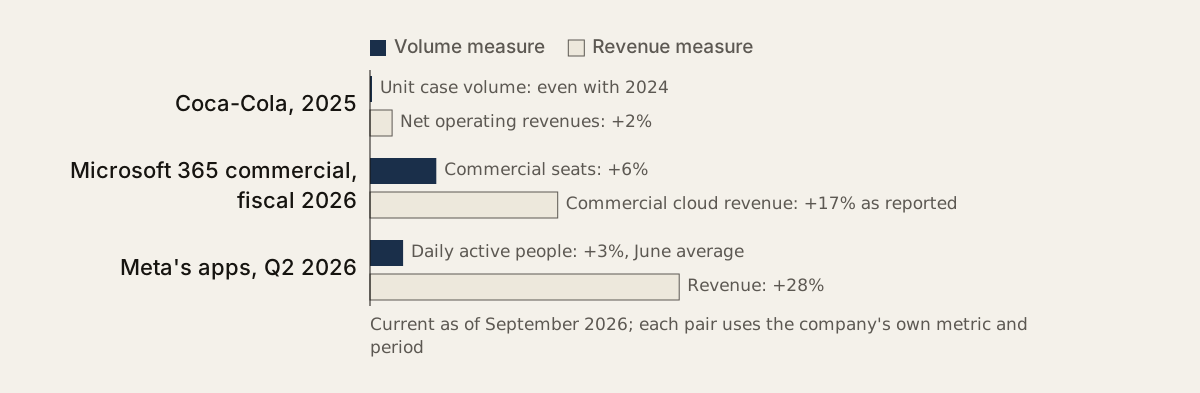
The number of buyers has stopped growing much, but the company keeps finding ways to earn more from each one.
An original diagram, free to reuse with a link to this page · Download the SVG
The pairs as text
- Coca-Cola, 2025: worldwide unit case volume even with 2024; net operating revenues up 2%.
- Microsoft 365 commercial, fiscal 2026: commercial seats up 6%; commercial cloud revenue up 17% as reported.
- Meta's apps, Q2 2026: daily active people up 3% on the June average; revenue up 28%.
Smartphones and the iPhone
By early 2023, IDC said smartphone refresh cycles had climbed past 40 months in most major markets.
Units are now falling while prices rise. Per IDC's final data, global shipments fell 7.4% year over year to 276.3 million in Q2 2026. IDC blames a memory crisis.
The leaders are moving upmarket. Apple and Samsung were the only top-five vendors to grow in the quarter, and Apple's iPhone 18 Pro, announced in September 2026, starts at $1,199 in the US, $100 above the iPhone 17 Pro's starting price. Apple promotes trade-in credit to people who already own an iPhone 13 or later.
Netflix
From its Q1 2025 results, Netflix stopped reporting quarterly membership numbers, and it now calls revenue and operating margin its primary financial metrics.
View hours grew 1.5% in 2025 and 2% in the first half of 2026. Revenue growth slowed from 17.6% in Q4 2025 to 13.4% in Q2 2026.
Its newer levers are price and ads. It made price changes in markets including the US, Mexico and Spain in the first half of 2026, and its ads plan, priced at $8.99 in the US as of April 2026, adds a revenue stream at a lower price point.
Netflix says it had reached less than 45% of its addressable broadband households by the end of 2025. I'd still call it mature, because viewing barely grows even with more than half those households left.
Meta's social apps
Daily active people across Meta's apps averaged 3.60 billion in June 2026, up 3% year over year after 6% growth a year earlier.
Money per user is growing far faster than users. In Q2 2026, ad impressions rose 14% and the average price per ad 12%. Revenue grew 28%. Meta's annual report says competing products such as TikTok have reduced some users' engagement.
Meta's answer is to put AI into its ad tools and earn more from each impression. Its CFO said the AI-powered Advantage+ ad tools reached over $75 billion in annual revenue run-rate in Q2 2026.
Coca-Cola
Coca-Cola's drinks have been sold in the US since 1886 and are now sold in more than 200 countries and territories.
Worldwide unit case volume in 2025 was even with 2024. Net operating revenues still rose 2%, and price and mix had a 4% favorable impact.
Coca-Cola Zero Sugar, a line extension, grew 14% in 2025.
Advertising costs rose too, to $5.4 billion in 2025 from $5.1 billion in 2024.
Gillette
P&G says its global blades and razors share is more than 60%, mostly through Gillette and Venus.
Grooming net sales rose 4% to $6.9 billion in fiscal 2026, but foreign exchange added 3 points and pricing 2 while unit volume fell 1%. North American volume fell because of market contraction, and grooming share slipped 0.4 points.
P&G is responding with innovation-based pricing and more marketing. Gillette has added blades before, from two with Trac II in 1972 to five with Fusion5 in 2006.
Microsoft 365 and Copilot
Microsoft said in 2025 that over 430 million people use Microsoft 365 apps. Its 10-K shows commercial seats grew 6% in fiscal 2026.
Microsoft 365 commercial cloud revenue grew 17% that year as reported, and Microsoft credits the rise in revenue per user to Microsoft 365 Copilot and E5.
This is the cleanest case of AI stretching maturity. Copilot was introduced in March 2023, embedded in the Office apps people already used.
The price Microsoft announced in July 2023 was $30 per user per month for commercial customers, and by July 2026 it said Copilot had passed 30 million paid seats.
Gmail and Google Workspace with Gemini
Gmail launched in 2004, and in January 2026 Google said 3 billion users rely on it. The surer sign of maturity is that Google and Microsoft now move in step.
Google folded Gemini into its Workspace Business and Enterprise plans in January 2025. It said a Business Standard customer who had paid $32 per user per month with the Gemini add-on would now pay $14, only $2 more than Workspace without Gemini.
The same week, Microsoft put Copilot into its Microsoft 365 Personal and Family plans and raised their US price by $3 a month.
Google also tiers the AI. In January 2026 it began rolling out some AI features in Gmail to everyone at no cost, starting in the US in English, while others, like Proofread, went to Google AI Pro and Ultra subscribers.
Adobe Creative Cloud with Firefly
Adobe's creative suite is a mature leader facing a new kind of substitute. Its annual report names "AI-first creative tools" among its competitors.
Adobe's overall sales haven't flattened. The company reported record revenue of $6.76 billion for the third quarter of fiscal 2026, up 13%, but its latest 10-Q warns that customer price sensitivity and the frequent entry of new competitors may increase downward pressure on pricing.
Adobe made Firefly commercially available in September 2023 and brought Firefly-powered features like Generative Fill in Photoshop to several Creative Cloud apps.
Paid Creative Cloud plans have included an allocation of generative credits since that launch. Adobe sells the AI through the subscription its customers already pay for instead of leaving it to the AI-first tools.
Google Search with AI Overviews and AI Mode
In the US government's search antitrust case against Google, the court's September 2025 remedies opinion noted that Google's share grew from 80% in 2009 to 89.2% by 2020, and said no existing rival has wrested share from Google.
The same opinion says tens of millions of people use chatbots like ChatGPT, Perplexity and Claude for information they used to get from search. It adds that they aren't yet close to replacing search engines.
Google built the substitute into the product with AI Overviews in 2024 and AI Mode in 2025. Search and other revenue grew 17% in Q2 2026, after single-digit growth in 2022 and 2023. Alphabet's Q2 2026 10-Q credits queries, advertiser spending and ad formats for that growth. It doesn't name AI as a driver.
Zoom
Zoom's revenue grew 326% in fiscal 2021, during the pandemic, and 4.4% in fiscal 2026. Its 10-K lists higher market penetration and "the maturation of our business" among the factors that have contributed and may contribute to slower growth.
Revenue from Online, the customers who subscribe directly on Zoom's website, grew 0.6% in the quarter ended July 31, 2026. Enterprise revenue still grew 7.8% in the quarter, so I'd put Zoom in late maturity rather than decline.
AI Companion is included at no additional cost for users with eligible paid Zoom services, and the 10-K says Zoom believes its free AI features will improve retention and drive revenue.
Salesforce Sales Cloud and Service Cloud
In fiscal 2026, Salesforce's Agentforce Sales (formerly Sales Cloud) brought in $9.03 billion in subscription and support revenue and Agentforce Service (formerly Service Cloud) $9.82 billion, each up 8%.
Eight percent on a base that size is late maturity.
Salesforce announced a 6% average list price increase for Enterprise and Unlimited Editions of Sales Cloud and Service Cloud from August 1, 2025, and in September 2026 launched new bundled editions starting at $195 per user per month.
Coursera and Udemy
Online learning shows the consolidation end of maturity. Coursera announced an all-stock combination with Udemy in December 2025 and completed it on May 11, 2026.
Udemy's 2025 revenue was up 0.4%. Its consumer revenue fell 9%, and it said it increasingly competes with large language models. I think AI is speeding up consolidation.
The deal's financial case leaned on $115 million of anticipated annual run-rate cost savings within 24 months of closing.
Coursera is building Project Helix, an AI-native skills platform it expects to make broadly available to enterprise customers in the first half of 2027. As of September 2026 the two still run as separate platforms.
Common Mistakes in the Maturity Stage
The most common mistake in the maturity stage is treating slower growth as decline and starving a product that still pays for everything else. A mature product still has its buyers. A product in decline is losing them to something else, and the two need very different budgets.
Raising prices with nothing new attached is the other trap. Customers trade down, a risk P&G's own 10-K names for Gillette.
What a Product Manager Should Focus On in the Maturity Stage
A product manager in the maturity stage should focus on retention and on keeping the core product funded.
Know your retention numbers better than your acquisition numbers. Zoom's trailing 12-month net dollar expansion rate for enterprise customers was 99% in the quarter ended July 31, 2026, up from 98%. By Zoom's definition, anything under 100% means those customers' recurring revenue averaged below its level a year earlier.
An AI feature keeps costing money after launch, so score it on the value it creates against the cost to build and run it, the way my AI roadmap for small businesses scores workflows on hours saved and complexity.
Give the core its share of the product roadmap. Much of a mature product's engineering time sits in the maintenance and monitoring phase of the SDLC, and that work gets squeezed out if every slot goes to the new AI feature.
RELATED READING
Product Life Cycle - Definition and Examples (2026)
The product life cycle (PLC) is the series of steps through which every product goes. Product life cycle stages - Introduction, Growth, Maturity and Decline.
Growth Stage Examples (2026) - 10 Rising Now, 2 Classics
The growth stage of the product life cycle is the second of its four stages, when sales climb fast because buyers beyond the early adopters of the introduction stage start buying. Unit costs usually…
Decline Stage Examples (2026) - 12 Products Past Their Peak
The decline stage is the last of the four product life cycle stages, when sales and usage fall because customers have moved to a substitute. The company's job at that point is to decide whether to…
The AI Roadmap for Small Business: Start to Scale
Most small business owners I talk to are stuck in the same place with AI. They've watched ChatGPT do something impressive. They've signed up for two or three SaaS products with "AI" in the name.…
Best Product Strategy Frameworks
Choosing the right product strategy framework is very important for every product manager. We will go over some top models like Kano, OKR, Hooked, etc. The same frameworks apply when you're shaping…
Product Roadmap Guide - Definition and Examples
Why are you building? What are you building? These two questions form the basis of any good product roadmap. Learn how to create the best product roadmap.
Top 9 Product Management Courses Online - Best Free and Paid (2026)
This is my list of the product management courses and certifications that are worth your time, updated for 2026. AI product management programs now lead the list. Once you've picked a course and…
FREQUENTLY ASKED
- What are some examples of products in the maturity stage?
- Smartphones, Netflix, Meta's social apps, Coca-Cola, Gillette, Microsoft 365, Gmail, Google Search, Zoom and Salesforce's core CRM are all in the maturity stage in 2026. Coca-Cola is the textbook case. Its worldwide unit case volume in 2025 was even with 2024, while price and mix had a 4% favorable impact on revenue.
- How long does the maturity stage last?
- It's usually the longest of the four stages, and for a strong brand it can run for decades. Coca-Cola's drinks have been sold in the US since 1886, and Gmail launched in 2004. The stage ends when a product's existing customers move to a substitute.
- How do companies use AI to extend the maturity stage?
- They add AI to the product customers already use instead of launching a new one. Microsoft priced Microsoft 365 Copilot at $30 per user per month for commercial customers in July 2023 and said in July 2026 that it had passed 30 million paid seats. Google included Gemini in its Workspace Business and Enterprise plans in January 2025. Zoom includes AI Companion at no additional cost for users with eligible paid plans, and says it believes its free AI features will improve customer retention.