Must know best 5 differences for Asana vs Trello. Every Product Manager and Project Manager should compare and check which tool is better for your startups.
Both tools have their pros and cons.
But, depending on your team strength and resources, each tool has the potential to become an integral part of your software development life cycle (SDLC).
Product Management Tools - Asana vs Trello
There is a plethora of tools available out there.
Not only that, there is a variety of tools available for every single task that any PM can possibly imagine.
The only task for which a tool is not available is the art of influencing without authority.
And for some reason, each tool has its definite list of pros and cons. In other words, there is definitely something or the other missing in every tool.
To get a comprehensive view of the tools available in product management or project management, check out the list of the top 10 PM tools.
Trello Review
Trello is a great tool for Kanban enthusiasts.
It is obviously more than a simple Kanban board. But, it is nevertheless an advanced form of Kanban agile methodology.
This would also be a good time to check out the top 15 benefits of Kanban.
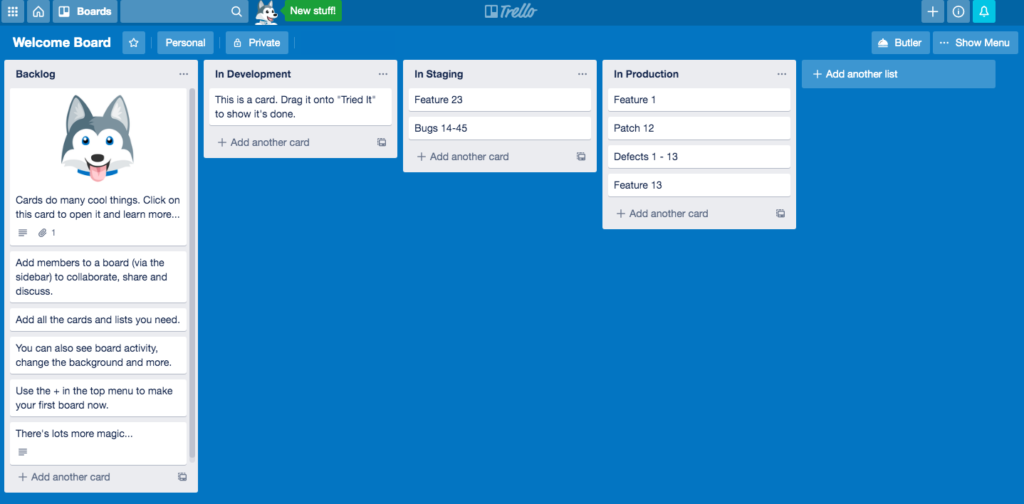
Additional Benefit - A cute doggy greets you when you open Trello.
Asana Review
Asana is a full suite product and project management software.
It offers multiple workstreams and user flows to cover practically all use cases in product management.
It is meant to be a one stop solution for everything a Product Manager can possibly need to do.
Asana projects as part of Asana for personal use is also very popular.
Asana personal users generally use it for their side projects.
With that being said, a fairer comparison will be between Asana and Atlassian, Asana and Trello.
But, for the purposes of this article, I will cover the top 5 differences in the following areas -
- UI/UX
- Pricing
- 3rd Party App Integrations
- Features
- Cross Platform Sharing
UI/UX
Trello (including the Trello app) has a very straightforward user interface. The UX is consequently very easy.
Given it is meant to do just one task, it does it really well.
This is probably one of the reasons why Atlassian bought Trello.
Atlassian is known for designing products with a beautiful UI and UX. For example, Jira is every PM's favorite tool.
Asana has a great UI and UX as well, but it is meant for more advanced users.
The UI may feel overwhelming in the beginning but that is for a reason.
Asana is simply a more comprehensive tool than Trello, and consequently, has a more complex UI and UX.
Pricing
Both products offer a free plan for beginners.
Trello's Free plan is for up to 10 collaborators and up to 10 boards per Workspace.
Above that, Trello's paid plans are Standard, Premium and Enterprise.
Standard is $5 USD per user per month billed annually ($6 billed monthly).
Premium is $10 USD per user per month billed annually ($12.50 billed monthly).
Enterprise is $17.50 USD per user per month billed annually.
Trello's AI features start at Standard.
Asana's free plan is called Personal. It is free for 2 users and gives you list, board and calendar views.
Asana's paid plans are Starter, Advanced and Enterprise, with Enterprise+ as a security and compliance tier above that.
Starter is $10.99 USD per user per month billed annually ($13.49 billed monthly).
Advanced is $24.99 USD per user per month billed annually ($30.49 billed monthly).
Enterprise is custom pricing through sales.
Asana's AI features are on every paid plan and not on Personal.
If you are searching for Asana Premium, that name is gone.
Trello pricing is better suited for very small teams who are just starting out.
Asana (including the Asana app) is better suited for teams that are fairly well established.
Given the size and scope of Asana, more established teams require better established processes.
This is where Asana comes in. Therefore, investing in the right tool depends mainly on how mature a product management or a project management team is.
The numbers above are USD list prices as of September 2026. The current ones are on Trello's pricing page and Asana's pricing page.
3rd Party App Integrations
Trello is blessed with the parentage of Atlassian.
Atlassian is known all over the product management and project management community for its wide variety of tools.
Some of the most famous tools like Jira and Confluence are built by Atlassian.
Trello was originally not a part of the Atlassian stable.
However, Trello was eventually bought by Atlassian and integrated into the Atlassian network.
It is now an indispensable part of the Atlassian ecosystem.
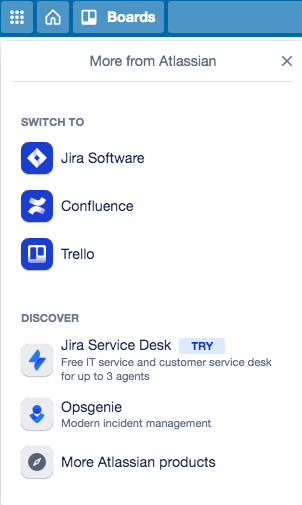
Given the near dominance of Atlassian in everything product management, Trello has a clear advantage here.
Atlassian capitalized on a great opportunity to buy out Trello.
Asana lists 100+ free integrations on every plan, including Microsoft 365, Google Workspace, Slack, Google Drive and Zoom.
Features - Trello vs Asana
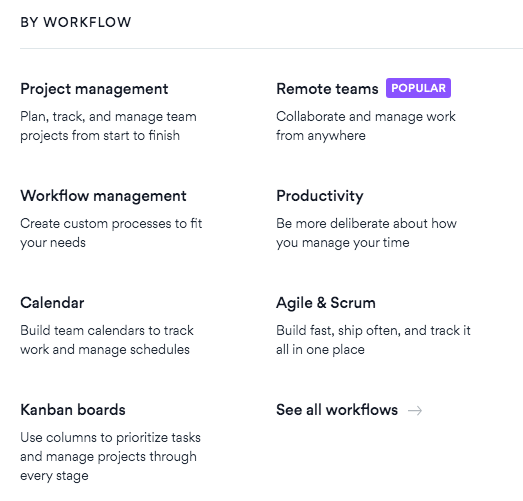
Trello itself is just a Kanban board with not many other features.
Trello was redesigned in 2025 around an Inbox and a Planner, rolled out to Free, Standard and Premium.
From Standard up, Trello's AI generates boards and checklists and pulls forwarded emails and Slack or Teams messages into Inbox.
It also drafts card descriptions and comments via Rovo and detects due dates from card titles.
A Workspace admin may need to enable Atlassian Intelligence first.
Asana on the other hand is a pretty comprehensive project management and product management tool.
Every paid Asana plan gets AI Teammates and Asana Dash, AI Assists, and AI Studio, a no-code builder for AI-driven workflows.
Heavier AI Studio use is a separately paid Plus or Pro option.
AI Connectors and MCP let you work in Asana from ChatGPT, Claude or Gemini.
Asana is the clear winner here. It can support any style that you want, including the OKR framework.
The AI inside both tools sits at the off-the-shelf end of the spectrum. A workflow that is specific to your business still needs something built for it.
Cross Platform Sharing
Both Asana and Trello can allow sharing across platforms.
In fact, both tools offer this flexibility because people understand that product teams do not use a single product.
More often than not, the same company uses multiple tools across multiple teams.
So, even within the same company, people sometimes need to make sure their tools are compatible and allow cross platform sharing.
Therefore, you can choose any tool that you want, as both handle sharing well.
In fact, pretty much any tool that you use, should offer these features.
If you find a tool that is very inward looking and does not offer collaboration options with other tools, then you need to look for another tool.
Conclusion - Asana vs Trello
That was a detailed comparison for Trello vs Asana. If neither fits, look at Jira, Monday or Linear.
At the end of the day, the tool is just a means to efficiently manage your product life cycle (PLC).
Don't let the tool become a task in itself. The tool should only be an enabler.
Too many Product Managers lose focus of the big picture by investing too much time in defining the right process.
Check out the list of the top 9 best product management courses.
RELATED READING
Top 10 Product Manager Tools (2026)
Free curated list of easy to use, must have top 10 Product Manager tools. These product management tools are recommended to help you become a successful PM!
Free Jira Tutorial: A Step-by-Step Training Guide
Learn the must know basics in this Jira Tutorial for Beginners. Understand all the critical functions that this wonderful tool can help you with. Basically, Jira is a Product Manager's best friend.
Top 15 Benefits of Kanban (and When to Pick It Over Scrum)
Kanban is a critical tool for a successful Product Manager. The top benefits of Kanban include clarity of purpose, clear picture of the project status, etc.
What is Agile Methodology?
What are the Basics of Agile Methodology? You have heard the phrase "Agile Methodology" practically thousands of time. Understanding Agile is at the heart of becoming Product Agnostic.
What Is A Healthy Product Backlog - Definition, Ownership and Overview
A healthy product backlog is a necessary starting point for any successful product life cycle. The product backlog is owned and managed by the product team.
Must Have Product Manager Skills
This is your critical Product Manager Skills List - Your Ultimate Guide to becoming a great PM. These necessary skills will ultimately define your success.
Custom AI Agents vs Off-the-Shelf Tools: When Each One Wins
The custom-vs-off-the-shelf question is the most common confusion I see in SMB AI conversations. Owners default to one side or the other based on temperament. Builders want custom. Frugal owners want…
FREQUENTLY ASKED
- Asana vs Trello: which one is better for small teams?
- Trello for very small teams (under 5) and visual-first workflows. Asana for teams over 5 that need multiple views (list, timeline, board) and more structured project management. Trello's strength is simplicity; Asana's strength is depth. If you're outgrowing Trello, you'll know.
- Can I use both Asana and Trello together?
- Some teams do, but it usually ends up as duplicate sources of truth and confusion about where work lives. Better to pick one and commit. If different teams genuinely need different tools (engineering on Linear, marketing on Asana, design on Trello) that's fine, but each team should have one home for work.
- Is Asana or Trello better for agile teams?
- Trello fits kanban naturally because the visual board is the primary view. Asana fits both kanban and scrum because the multiple views support either flow. For pure scrum with sprints, story points, and release planning, Jira or Linear usually beat both. The choice depends less on agile method and more on how much process the team wants visible.