OKR stands for "Objectives and Key Results". To be a successful Product Manager, you need to fully understand the OKR Framework - a must know strategy.
To clarify, OKR is not a skill that can be learnt (unlike other critical product management skills), it is simply a style of functioning. You may already be using some version of the OKR framework, but you may not be aware of it. Within your scrum teams, clearly defining what kind of framework you use will help in bringing organisational clarity to your stakeholders.
OKR Framework Origin
But where did this framework come from? And why has it become so popular?
Answering the first question will automatically give you the answer for the second question.
Andy Grove, then Intel's president and chief operating officer, had first come up with the OKR method. John Doerr, who learnt it from Grove at Intel, took the concept of OKRs with him when he went to work for the legendary venture capital firm Kleiner Perkins. In 1999, Doerr, by then an early investor and board member at a little known startup, introduced the concept of OKRs to its founders.
That little known startup was Google.


The rest, as they say, is history.
I wish we had this book 19 years ago, when we founded Google.
Larry Page, Google Co-Founder, on John Doerr's book Measure What Matters
OKRs became a core part of how Google runs. And given their obvious success, the OKR framework in general has become wildly popular. If you are looking for successful OKR examples, Google is the best known one.
As the Product Manager, it is your responsibility to set the objectives. You can use any tool that you already have - Jira is a good starting point.
OKR Meaning
At its core, the OKR Framework brings discipline within the team because you need to clearly define your objectives. Not only that, you need to make sure you are able to achieve your key results.
However, it is very important to not fall into the trap of the Waterfall model. OKR can and should be used only with the Agile Methodology.
Many people make the mistake of getting fixated on pre-defined objectives, failing to take constant feedback and completely abandoning the Agile processes.
To help prevent this trap of falling into the Waterfall model, you need to keep all communication channels open. Don't forget to communicate like a boss!
An objective is a clearly defined goal (with a clear timeline) that you as a Product Manager need to set. Nobody else should set the goal besides you (not the Scrum Master, Dev Lead, etc.).
Refresh your memory on the difference between a Product Manager and a Product Owner.
A Key Result is a measurable outcome for the quarter that shows whether the Objective is being met. It can use a KPI (Key Performance Indicator) as its measure, but a KPI on its own is not a Key Result.
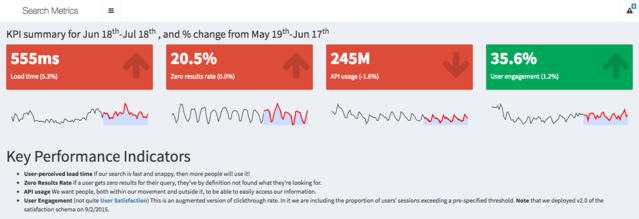
KPI Example
Screenshot by MPopov, WMF (resized) · CC BY-SA 3.0 · Source

OKR Product Management
No matter the product, OKR fits any management style.
In other words, this framework is Product Agnostic.
And as far as OKR software is concerned, there are many available on the market. But you can easily use any existing tool for your OKR metrics.
As a Product Manager, it is also important to create realistic goals and measurable key results. Keeping open ended goals with vague metrics is not only counter productive, it is actually demoralizing for the team.
I always break down my bigger objectives into smaller and more manageable objectives. Then, I create many small KPIs to help understand my progress.
It is also important to have a fixed timeline for all your KPIs. A KPI becomes meaningless if there are no fixed timelines.
Also, it is a good practice to connect your OKRs to your larger product roadmap. It helps if you can demonstrate that a certain OKR is a natural bridge to a future feature or enhancement. This applies just as much when the roadmap includes AI work. A vague objective is the usual reason an AI roadmap goes nowhere.
I also want to add in a point about product roadmaps here. Always try to be as detailed as possible in your product roadmap. However, don't keep your features dependent on a fixed outcome of a previous OKR. Give yourself the buffer to proceed or update your roadmap based on your KPI results.
OKRs give all stakeholders a quantitative and a measurable sense of where the product stands.
OKR Examples
Let us look at a few examples.
Example 1: Scaling a B2B SaaS Platform for Enterprise Adoption
Objective: Become the go-to enterprise solution in the HR tech space by Q4
This objective is ambitious, time-bound, and outcome-oriented. It’s not about building features - it’s about becoming the choice for enterprise clients.
Key Result 1: Increase enterprise customer base from 15 to 50 by end of Q4
-
Why it matters: Growth in enterprise clients is a direct signal of product-market fit at scale.
-
How to measure: CRM data, signed contracts, and ARR contribution.
-
PM focus: Collaborate with Sales to identify friction in the onboarding funnel and prioritize roadmap items that reduce time-to-value.
Key Result 2: Achieve 95%+ SLA compliance for enterprise-tier customers
-
Why it matters: Enterprise clients demand reliability. SLA breaches erode trust.
-
How to measure: Monitoring tools (e.g., Datadog, PagerDuty), incident reports.
-
PM focus: Partner with SRE and Engineering to identify systemic risks and prioritize reliability epics over net-new features.
-
The key is to keep it simple - don't forget the KISS principle.
Key Result 3: Launch 3 enterprise-specific features with >80% adoption within 60 days of release
-
Why it matters: Feature usage is a proxy for value delivery.
-
How to measure: Feature flags, usage analytics (e.g., Amplitude), customer feedback.
-
PM focus: Use JTBD interviews to validate feature concepts, run closed betas, and iterate quickly.
Key Result 4: Net Promoter Score (NPS) of 60+ from enterprise accounts
-
Why it matters: NPS is a leading indicator of retention and expansion.
-
How to measure: Quarterly NPS surveys segmented by account tier.
-
PM focus: Work with Customer Success to close the loop on feedback and identify product gaps.
Why this OKR works for senior PMs:
-
It is about outcomes that align with business strategy, not just shipping.
-
Each KR is measurable, time-bound, and cross-functional.
-
It forces prioritization: reliability over velocity, adoption over vanity metrics.
Example 2: Driving Product-Led Growth (PLG) in a Freemium Mobile App
Objective: Accelerate self-serve revenue through product-led growth by Q3
This objective is about monetization through user behavior, not sales-led tactics.
Key Result 1: Increase free-to-paid conversion rate from 3.2% to 6%
-
Why it matters: Conversion is the metric PLG lives or dies on.
-
How to measure: Funnel analytics, cohort tracking.
-
PM focus: Run A/B tests on paywall timing, pricing tiers, and feature gating. Use Mixpanel or Heap to analyze drop-off points.
Key Result 2: Reduce time-to-value (TTV) for new users from 2.5 days to under 1 day
-
Why it matters: Faster TTV = higher activation and retention.
-
How to measure: Onboarding analytics, user journey mapping.
-
PM focus: Redesign onboarding flow using progressive disclosure and contextual nudges. Validate with usability testing.
Key Result 3: Launch in-app referral program with 10K+ successful referrals in Q3
-
Why it matters: Virality is a PLG multiplier.
-
How to measure: Referral codes redeemed, new users acquired via referrals.
-
PM focus: Collaborate with Growth and Design to build a smooth referral UX. Incentivize both sender and receiver.
Key Result 4: Increase average revenue per user (ARPU) by 25%
-
Why it matters: Monetization efficiency is key to sustainable growth.
-
How to measure: Revenue dashboards, segmented by user type.
-
PM focus: Introduce microtransactions or premium bundles. Use pricing experiments to find elasticity sweet spots.
Why this OKR works for senior PMs:
-
It’s deeply tied to user behavior and business outcomes.
-
It encourages experimentation and rapid iteration.
-
It balances acquisition, activation, and monetization.
Pick one North Star Metric (activated users, for example) and track all four key results against it.
Conclusion - Measure What Matters
The OKR meaning should be clear to you now. Some people also ask about OKR vs KPI. But that is not a valid comparison. A KPI measures the ongoing health of the product. An OKR sets a time-bound goal for change.
In conclusion, setting up stretch goals and reaching for them is the hallmark of the OKR framework. Use your intuition and judgement while setting up these objectives. You already know the Business Requirements. You already know the Development Team capacity. Your job is to find the perfect match between the two. This is where your knowledge and experience will come in handy.
Other online resources include the most famous OKR book - Measure What Matters (also on Amazon), some OKR best practices and some OKR examples.
RELATED READING
Best Product Strategy Frameworks
Choosing the right product strategy framework is very important for every product manager. We will go over some top models like Kano, OKR, Hooked, etc. The same frameworks apply when you're shaping…
Must Have Product Manager Skills
This is your critical Product Manager Skills List - Your Ultimate Guide to becoming a great PM. These necessary skills will ultimately define your success.
Product Roadmap Guide - Definition and Examples
Why are you building? What are you building? These two questions form the basis of any good product roadmap. Learn how to create the best product roadmap.
Product Manager vs Project Manager: Key Differences
90% of people don't know the difference between a Product Manager vs a Project Manager - but the differences are fairly simple - a must know for any PM!
Best Leadership Qualities - Top Examples, Definition and Skills
The best leadership qualities and skills need to be developed over time. Learn from some of the best leadership examples to accelerate your career growth.
What Does A Product Manager Do - Job Description, Role & Responsibility
The Product Manager Job Description has a few things in common across companies. Essentially, the Product Manager is the CEO and the janitor of the product.
The AI Roadmap for Small Business: Start to Scale
Most small business owners I talk to are stuck in the same place with AI. They've watched ChatGPT do something impressive. They've signed up for two or three SaaS products with "AI" in the name.…
FREQUENTLY ASKED
- What does OKR stand for?
- Objectives and Key Results. The objective is the qualitative goal. The key results are the three to five numeric outcomes that prove the objective is being met. Google made the framework famous after John Doerr brought it from Intel in the late 1990s.
- How are OKRs different from KPIs?
- KPIs measure ongoing operational health (uptime, churn, NPS). OKRs set time-bound stretch goals for change (move churn from 5% to 3% by end of Q3). The two complement each other. A team can have stable KPIs and aggressive OKRs at the same time.
- Why do most companies struggle with OKRs?
- Three reasons show up most often. They turn OKRs into a performance management tool, which makes people pick safe targets. They confuse activities with results, so the key results read like a to-do list. And they set too many OKRs, so nothing is actually prioritized. Pick three objectives, write them clearly, and stop.