Personal transport NOV 23, 2026 6 MIN READ
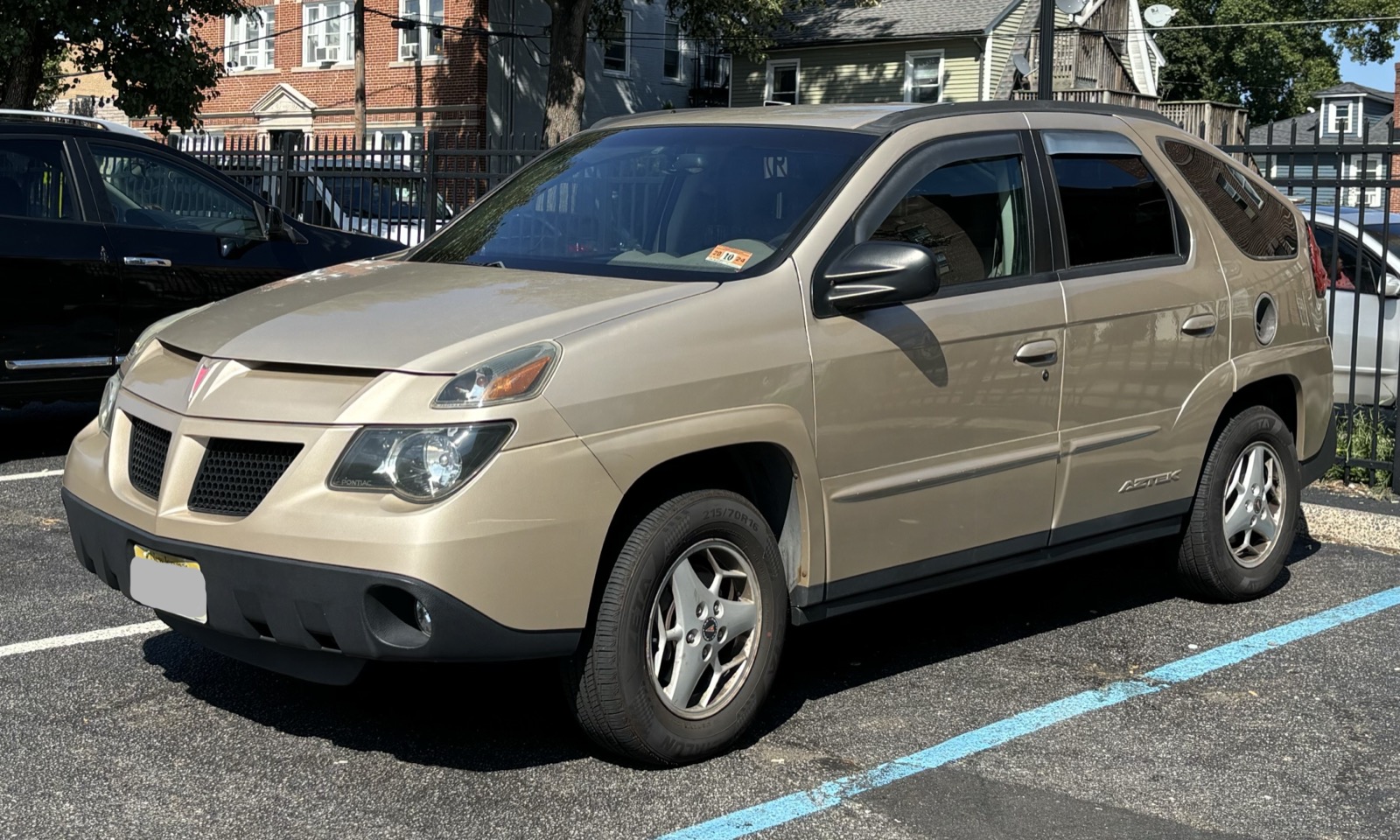
Pontiac Aztek
My post on failed products examples covers twelve famous cases from tech and why each one failed.



The timeline as text
- 1994A sketch called Project Bear Claw inspired the design
- January 1999The Aztek show car debuted in Detroit
- 2000Went on sale in mid-2000 as a 2001 model
- November 2000GM added a $500 rebate and cut its forecast to 50,000 a year
- 2001GM delivered 27,322 Azteks in the US
- 2002Deliveries reached 27,793 as GM set an industry SUV sales record
- April 2003WardsAuto reported production would end in December 2004
- 2005Pontiac ended the Aztek, Time later wrote
- February 2006Pontiac's home page no longer listed the Aztek
- Company
- General Motors
- Category
- Personal transport
- Launched
- 2000
- Ended
- 2005
- Stage reached
- Introduction
- AI product
- No
- Status
- Time wrote in 2010 that Pontiac ended it in 2005; Pontiac's site listed no Aztek by February 2006
Reporting at the time blamed the Pontiac Aztek's weak sales on its looks and on a price too high for the young buyers GM wanted. GM had first forecast 75,000 sales a year, BusinessWeek reported, and delivered 27,322 in 2001, its first full year on sale.
What it was
The Pontiac Aztek was a sport-utility vehicle that General Motors built on its minivan platform and put on sale in mid-2000 as a 2001 model.
It started as a 1994 sketch called Project Bear Claw, drawn in GM's design studio in Thousand Oaks, California, BusinessWeek reported. Bear Claw called for a smaller vehicle, "more like a tall wagon with rugged styling."
A couple of years after the first drawings, GM's engineers decided to use the minivan platform "to get to market quickly and affordably," BusinessWeek wrote. The Aztek show car debuted in Detroit in January 1999.
GM aimed it at buyers in their twenties and thirties. Options included a bike rack, a cooler and a $195 camping package, a tent that attached to the back, Forbes reported. Don Butler, the Aztek's brand manager, said it was "built for independent thinkers and early adopters."
What happened
The Aztek sold far below GM's plan from its first months.
In its first four months it averaged about 2,000 sales a month, against 8,000 a month for Ford's new Escape, BusinessWeek reported in December 2000. GM had added a $500 rebate in November and cut its annual sales forecast to 50,000, from the original 75,000.
All-wheel drive wasn't offered at launch. In November 2000, Forbes reported that the Versatrak system would become an option that January.
GM's own figures put US deliveries at 27,322 in 2001 and 27,793 in 2002. The same release said GM's overall SUV sales had set an all-time industry record in 2002.
In April 2003, WardsAuto reported that GM would stop making the Aztek in December 2004, citing industry sources. Jim Vurpillat, the Aztek's marketing manager, wouldn't confirm it. "It's not going anywhere, at least for now," he said. By then Pontiac was offering $2,000 cash or financing at 0% to 2.9%.
Pontiac's own site still listed it in February 2005. In February 2006, the vehicles listed on Pontiac's home page no longer included it. Time wrote in 2010 that Pontiac kept the car around "until finally mercy killing it in 2005."
Why it failed
Reporting at the time blamed the Aztek's price, its looks and its launch without all-wheel drive. Later accounts from inside GM blamed the way it was developed.
What General Motors said
No GM statement found for this entry gave a reason for dropping the Aztek. GM first defended the design, then talked about the cost of missed sales targets.
In December 2000, GM insisted to BusinessWeek that the Aztek was not a disaster. Tom Peters, the Aztek's chief designer, said, "We wanted to do a bold, in-your-face vehicle that wasn't for everybody."
Some GM officials privately acknowledged mistakes, the magazine reported. John Taylor, a GM executive director of design, named "concept drift" as one concern, which he described as "when you start with one thing and do another."
In 2003, Vurpillat told WardsAuto, "Anytime a vehicle doesn't hit sales targets, you're really going to have a lot of profit pressure." Ron Zarrella, a former president of GM North America, had said GM needed to sell about 30,000 Azteks a year to make money on the program, WardsAuto reported.
What reporting showed
At $22,000 to $27,000, BusinessWeek wrote, the Aztek was "overpriced for its original twenty- to thirtysomething market." Its average buyer was 46, against 42 for Pontiac overall. "They got greedy," said James Hall of the consulting firm AutoPacific, who added that utility vehicles were hot and GM had misjudged pricing.
Its looks split people. During development, GM's own research showed would-be buyers were "sharply polarized" over the styling, BusinessWeek reported, and by December 2000 it was "the vehicle people love to hate." Moving to the minivan platform gave it "the large, boxy dimensions of a minivan," the magazine wrote.
Forbes's November 2000 review called it "a truly unattractive car."
WardsAuto's 2003 account said the Aztek "flopped from the outset" without all-wheel drive at launch, and that it was "too expensive for the younger buyers it targeted."
What later analysis found
Bob Lutz, who said he "kind of got hired" as GM's vice chairman of product development because of the Aztek, gave his account of how it happened in Road & Track in 2014.
The concept car "was a much leaner vehicle," he wrote, with decent proportions. GM was being criticized for never taking a chance, so Rick Wagoner, who later hired Lutz, and GM's automotive strategy board decreed that 40 percent of all new GM products would be "innovative." That, Lutz wrote, started a trend toward "internal goals that meant nothing to the customer."
The Aztek failed GM's product clinics early on, by his account, and "scored dead last." Don Hackworth, who ran product development, said he didn't want "any negative comments about this vehicle," Lutz wrote, and GM "rejected the research."
One of the program's leaders later told Lutz he was proud of it: "We made all our internal goals, we made the timing."
Dan Neil wrote in Time in 2007 that later interviews with GM designers showed the design had been "cost-shaved and otherwise compromised" until the concept had been reduced to "a bulky, plastic-clad mess." Under all that, he wrote, "there was a useful, competent crossover."
Matthew DeBord argued in The Big Money in 2009 that GM had been "the first to recognize the need" for a crossover. He likened the Aztek to Apple's Newton, a failure that he said helped Apple begin to define a new market.
The stage it reached
The Aztek never left the introduction stage, the first of the four stages in the product life cycle, when sales are small and costs run well ahead of revenue.
Its price moved within months, a mark of the stage. GM added the $500 rebate in November 2000, and in 2003 Pontiac was still offering cash and cheap financing. Its 2001 and 2002 deliveries stayed under Zarrella's 30,000.
It never reached growth, so I count it as a failure, not a decline.
The lesson
I think the Aztek is the clearest case I know of a team grading itself on the wrong scoreboard. The program made its internal goals and its timing, one of its leaders told Lutz, while GM rejected clinic research in which it had scored dead last.
Make the customer's verdict a gate the plan can't pass without, not a data point a committed team can wave away.
Then watch for what Taylor called concept drift. The sketch GM started from called for a smaller vehicle, and the platform it picked for speed and cost gave the Aztek a minivan's boxy dimensions, BusinessWeek reported. When a constraint changes the product, put the changed version in front of buyers before you build it.
Causes at a glance
Reporting at the timePricing
At $22,000 to $27,000 it was overpriced for the young buyers it targeted
Reporting at the timeWeak demand
GM's own research found would-be buyers sharply polarized over its styling
Reporting at the timeRushed launch
WardsAuto said it flopped from the outset without all-wheel drive at launch
Company statementRushed launch
A GM design executive called concept drift one of GM's concerns
Source1
Company statementBusiness model and costs
GM needed about 30,000 sales a year to make money and sold under 28,000 in 2001 and 2002
Later analysisRushed launch
Bob Lutz said it scored dead last in GM's product clinics and GM built it anyway
Source10
Sources
- 1.BusinessWeek (David Welch), GM's Aztek: Born to Be a Little Too Wild
December 2000 · Reporting at the time
- 2.Forbes, 2001 Pontiac Aztek
November 2000 · Reporting at the time
- 3.General Motors, GM Reports Best December Sales Since 1979
January 2003 · Company statement
- 4.WardsAuto (Brian Corbett), Farewell, Aztek
April 2003 · Reporting at the time
- 5.Pontiac (General Motors), Pontiac | Aztek | Models
February 2005 · Company statement
- 6.Pontiac (General Motors), Pontiac.com - Designed for Action
February 2006 · Company statement
- 7.Time (Dan Neil), The 50 Worst Cars of All Time: 2001 Pontiac Aztek
September 2007 · Later analysis
- 8.The Big Money (Matthew DeBord), Montezuma's Aztek Revenge
November 2009 · Later analysis
- 9.Time (Dan Fletcher), The 50 Worst Inventions: Pontiac Aztek
May 2010 · Later analysis
- 10.Road & Track (Bob Lutz), How Bad Cars Happen: The Pontiac Aztek debacle
October 2014 · Later analysis
More from the graveyard
Nov 1959
Edsel
Ford Motor Company Personal transport
Ford confirmed on November 19, 1959 that it had discontinued the Edsel
Oct 1982
DeLorean DMC-12
DeLorean Motor Company Personal transport
Production stopped in May 1982, and the receivers began the Belfast plant's final rundown on October 19, 1982
2019
Tata Nano
Tata Motors Personal transport
Tata Motors built no Nanos in 2019 and never formally announced the end
Feb 1998
Apple Newton
Apple Consumer hardware
Apple announced the end of Newton development on February 27, 1998