Personal transport · OCT 7, 2026 · 8 MIN READ
Tata Nano
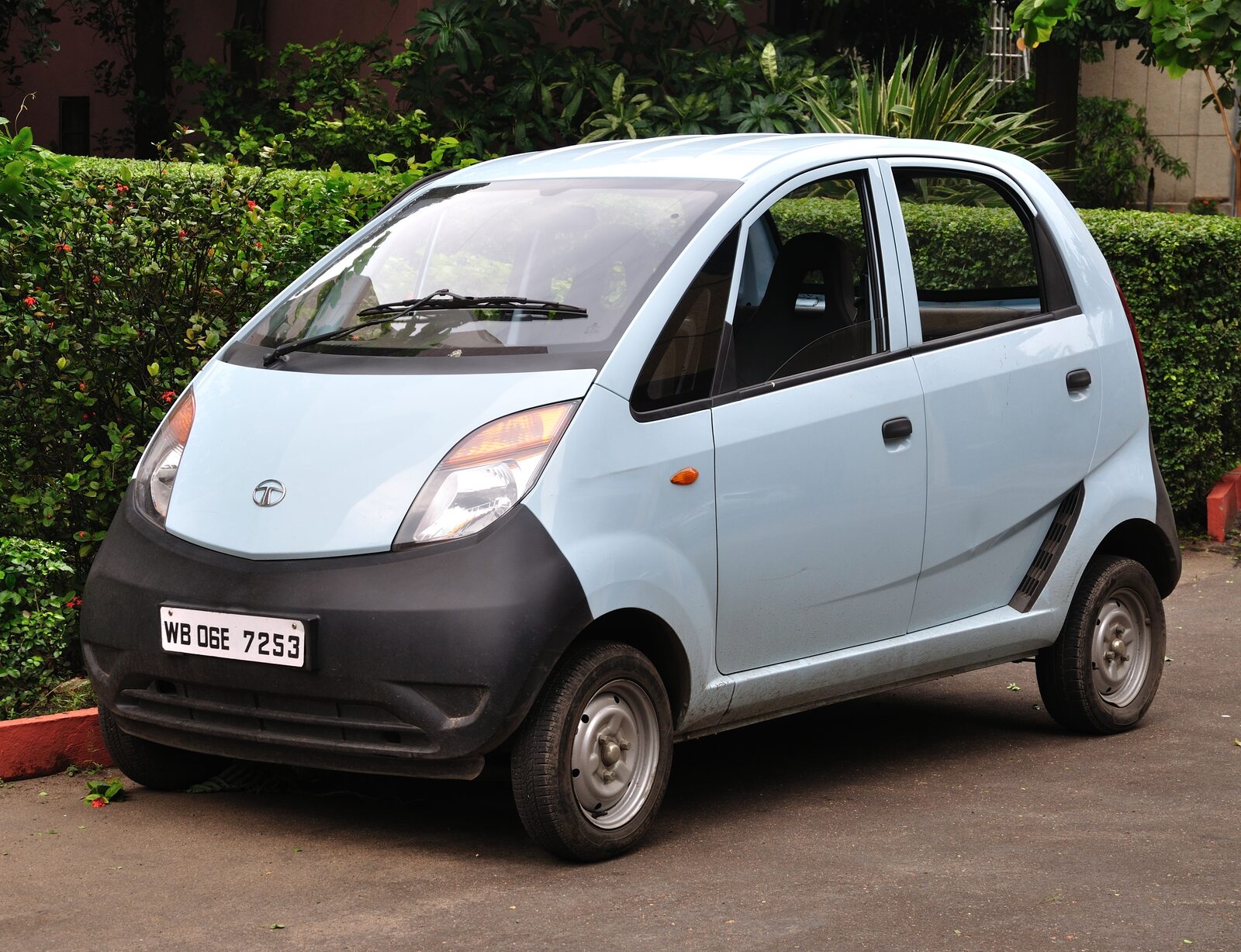

- Company
- Tata Motors
- Category
- Personal transport
- Launched
- March 2009
- Ended
- 2019
- Stage reached
- Introduction
- AI product
- No
- Status
- Tata Motors built no Nanos in 2019 and never formally announced the end
Ratan Tata promised a car for Rs 1 lakh, and Tata Motors launched it in 2009 to more than 200,000 bookings. By 2019 Tata had quietly stopped building it.
What it was
The Tata Nano was a small car that Tata Motors built to sell for 100,000 rupees, or Rs 1 lakh, to Indians who rode two-wheelers.
It was Ratan Tata's idea. The New York Times reported that the Tata Group chairman told his engineers to build a car at that price for people "who would otherwise be making do with motorcycles and scooters."
Ratan Tata called it the people's car, PTI reported.
At launch it had a 623-cc two-cylinder engine with about 30 horsepower, the Times reported, and airbags, antilock brakes and even a radio weren't available.
Tata Motors priced the standard version at Rs 1 lakh ex-factory, before transport charges and VAT. "We have made a promise and we have kept that promise," Ratan Tata said at the launch.
What happened
Tata Motors unveiled the Nano in January 2008, delivered the first one in July 2009 and stopped building it after 2018.
When Tata took the covers off it at the Auto Expo on January 10, 2008, The New York Times called it the world's cheapest car.
The Nano's plant was going up at Singur in West Bengal, where protesters held rallies and blocked roads, The Economist reported.
On October 3, 2008, Tata Motors said it would move the Nano project out of the state, and blamed "agitative actions" by the opposition party led by Mamata Banerjee. The factory went to Gujarat.
Tata launched the car in Mumbai on March 23, 2009, "a good nine months before the new plant has come on-stream," Ratan Tata said.
In May, Tata Motors reported more than 2.03 lakh fully paid bookings. It handed over the first car, in Mumbai, on July 17.
Because the factory had to move, the Times reported, it took more than a year and a half to fill the orders for the first 100,000 cars.
Then sales slumped. Tata sold 509 Nanos to its dealers in November 2010, against 9,000 in July, the Times reported.
Yearly sales peaked at 74,527 in the year to March 2012 and fell to 21,129 two years later, The Indian Express reported.
Tata kept revising the car, and the GenX Nano of May 2015 added an automated manual gearbox and an openable hatch.
In October 2016, in a letter written the day after he was ousted as chairman of the Tata Group, Cyrus Mistry said the Nano's costs "were always above" Rs 1 lakh and that it had "consistently lost money, peaking at Rs 1,000 crore." He wrote that "emotional reasons alone" had kept it from being shut down, PTI reported.
A Tata Motors spokesperson said in September 2017 that the Nano had an "emotional connect" with the Tata Group, and that until an update "in the months to come" the company would keep producing it "catering to customer demand in key markets," Overdrive reported.
In January 2020 PTI reported that Tata had built no Nanos in 2019 and sold one, in February, and that the company was "yet to officially retire" the car.
Why it failed
Tata Motors blamed the Nano's cheap image and the delays from moving its factory. Reporting at the time added fires, a zero-star crash test and buyers who didn't want to be seen in a poor man's car.
What Tata Motors said
Tata Motors said the fires were caused by "foreign electrical equipment" found on top of the exhaust system and that the car was safe, the Times reported in December 2010.
Ratan Tata, who had stepped down as chairman of the Tata Group in 2012, told CNBC in 2013 that the Nano "should have been marketed towards the owner of a two-wheeler." It was termed the cheapest car by the public, he said, and "by the company when it was being marketed."
Harvard Business School's summary of a 2015 interview with him says he argued that the company underestimated how much buyers at the base of the pyramid wanted status, and "wrongly positioned the brand as a product which a consumer would buy if they could not afford to buy another car."
In a filing to the BSE in November 2016, after Mistry's letter, Tata Motors said it had set up capacity for around 250,000 cars a year. It blamed "project delays due to change in location of the factory" and "the perception of being a 'low priced' car" for the volumes that never came, and called the Nano a loss-making product, the Hindustan Times reported.
The closest it came to a reason for stopping was the cost of new rules due in 2020. "We may not invest in upgrading all the products and Nano is one of them," Mayank Pareek, president of passenger vehicles at Tata, told reporters in January 2019, AFP reported. By January 2020 the company had admitted, PTI reported, that the Nano in its current form wouldn't meet the new safety and BS-VI emission rules.
What reporting showed
The New York Times reported in December 2010 that the Nano had been hurt by reports of fires in a handful of cars. Darius Lam, an analyst at J.D. Power, told the paper: "The company has just mishandled the whole thing."
AFP reported in January 2012 that the status-conscious buyers the Nano targeted had "largely shunned the 'cheap' tag" and gone for "slightly pricier rivals, or second-hand vehicles costing the same." Punnoose Tharyan, editor of Motown magazine, told AFP the Nano was "always bandied about as a poor man's car" and "Nobody wants to be caught with it."
In January 2014 The Guardian reported that the Nano had received a zero-star adult protection rating in a crash test and "failed to meet even the most basic UN safety requirements."
As the end neared in January 2019, Hormazd Sorabjee, editor of Autocar India, told AFP: "It was a marketing failure." The idea of the Nano as an alternative to a motorcycle, he said, was "great as a concept but not as a marketing slogan."
What later analysis found
Vanessa Able argued in a Guardian opinion column in February 2014 that calling the Nano the world's cheapest car made it "sound flimsy and unreliable instead of no-frills and accessible." She wrote that Tata had ignored the car's main fans, middle-class urban youth, and focused on first-time buyers in rural areas.
The stage it reached
The Nano stalled in the introduction stage and then shrank, without ever reaching growth.
Three years after launch, Tata had sold 1.75 lakh Nanos in all, The Indian Express reported. That was fewer than the bookings it took in 2009.
In late 2010 Tata was still teaching buyers, offering test drives through new small showrooms in smaller cities to reach people "who may not be comfortable walking into conventional car dealerships," the Times reported.
Its best year was under a third of the capacity Tata said it had set up. Like the Segway, it had a factory built for far more buyers than turned up.
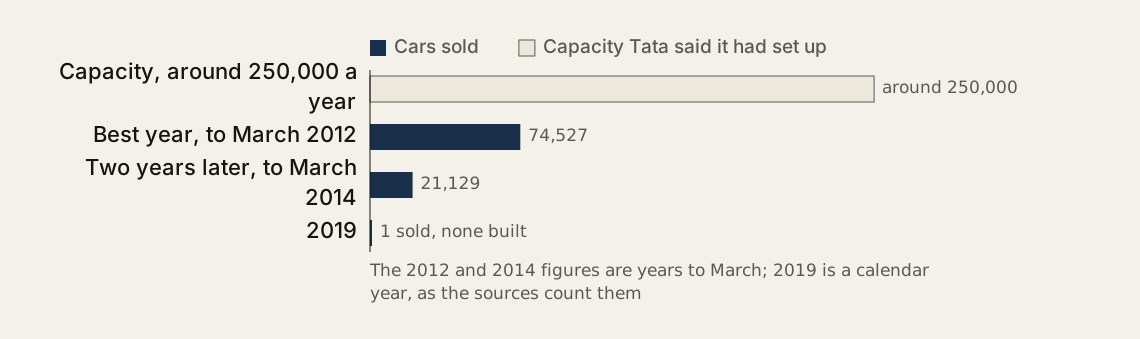
Capacity from Tata Motors' November 2016 BSE filing via the Hindustan Times; sales from The Indian Express and PTI. The 2012 and 2014 figures are years to March; 2019 is a calendar year, as the sources count them.
An original diagram, free to reuse with a link to this page · Download the SVG
The chart as text
- Capacity Tata said it had set up: around 250,000 cars a year.
- Best year, to March 2012: 74,527 sold. Two years later: 21,129.
- 2019: one sold, none built.
In the growth stage, cheaper versions appear to reach the next group of buyers. The Nano went the other way. It launched at Rs 1 lakh ex-factory, and the GenX Nano started at Rs 1.99 lakh ex-showroom in Delhi in 2015.
Sales grew just 6% in the year to March 2012, the Nano's best.
The lesson
I think the Nano is the clearest case of a price turning into a product's identity. Ratan Tata said he meant it as an all-weather family car for people on two-wheelers, and the message that reached them was "cheapest car."
People buy what a product says about them as well as what it does. Google Glass had the same problem, a product that said something about its owners they didn't want said.
If you're building the cheap option, test the name and the launch message on the people you built it for, and ask whether they'd be happy to be seen in it.
Causes at a glance
Company statement · Unclear value
Marketed as the cheapest car, not as a safe upgrade for two-wheeler riders
Reporting at the time · Social acceptance
Status-conscious buyers saw a poor man's car and bought rivals or used cars
Company statement · Timing
Moving the factory out of Singur delayed production and slowed deliveries
Reporting at the time · Quality and reliability
A few cars caught fire, and a crash test gave it a zero-star adult rating
Company statement · Business model and costs
Tata called it loss-making and said it might not upgrade it for new rules
Sources
- 1.Tata Motors, Tata Motors keeps its Nano price promise
March 2009 · Company statement
- 2.The New York Times, Tata's Nano, the Car That Few Want to Buy
December 2010 · Reporting at the time
- 3.Morung Express (PTI), Tata Nano ends 2019 with zero production, sales of 1 unit
January 2020 · Reporting at the time
- 4.The New York Times, Tata Nano Launched in Mumbai
March 2009 · Reporting at the time
- 5.The New York Times, Tata Nano: The World's Cheapest Car
January 2008 · Reporting at the time
- 6.The Economist, Nano wars
August 2008 · Reporting at the time
- 7.Tata Motors, Tata Motors to relocate Nano Project from Singur
October 2008 · Company statement
- 8.Tata Motors, Tata Nano draws over 2.03 lakh bookings
May 2009 · Company statement
- 9.Tata Motors, Tata Motors delivers first Tata Nano in the country in Mumbai
July 2009 · Company statement
- 10.The Indian Express, Sales of Tata Nano, world's cheapest car, set to hit six-year lows
March 2015 · Reporting at the time
- 11.Tata Motors, Tata Motors launches the GenX Nano range, its new compact hatch
May 2015 · Company statement
- 12.Business Today (PTI), Cyrus Mistry says Tatas not shutting production of loss-making Nano due to emotional reasons
October 2016 · Reporting at the time
- 13.Overdrive, Tata Motors to continue Tata Nano production for now
September 2017 · Company statement
- 14.The Indian Express, Two years on, Tata Nano sales yet to hit top gear
April 2012 · Reporting at the time
- 15.CNBC, India tycoon still has big hopes for little Nano
November 2013 · Company statement
- 16.Harvard Business School, Ratan Naval Tata, Creating Emerging Markets interview
Company statement
- 17.Hindustan Times (IANS), Nano a loss-making product, says Tata Motors
November 2016 · Company statement
- 18.Gulf News (AFP), 'World's cheapest car' nears end of the road in India
January 2019 · Reporting at the time
- 19.New York Daily News (AFP), Cheap proves costly for Tata Nano in status-conscious India
January 2012 · Reporting at the time
- 20.The Guardian, Tata Nano safety under scrutiny after dire crash test results
January 2014 · Reporting at the time
- 21.The Guardian, Tata Nano: the car that was just too cheap
February 2014 · Later analysis
- 22.Time, Reinventing the Wheel
December 2001 · Reporting at the time
- 23.The New Atlantis, America at 10 M.P.H.
June 2004 · Reporting at the time
- 24.Reuters (via The Christian Science Monitor), Is this the end of Google Glass? Some early believers think so.
November 2014 · Reporting at the time
- 25.BBC News, Google Glass sales halted but firm says kit is not dead
January 2015 · Reporting at the time
More from the graveyard
Jul 2020
Segway PT
Segway · Personal transport
Segway retired the PT and ended its US production on July 15, 2020
Mar 2023
Google Glass
Google · Wearables
Google stopped selling Glass Enterprise Edition on March 15, 2023
Sep 2014
Orkut
Google · Social networks
Google shut Orkut down on September 30, 2014
Dec 2020
Quibi
Quibi · Streaming
The app stopped working on December 1, 2020; Roku bought its content distribution rights in January 2021