Personal transport NOV 6, 2026 6 MIN READ
Edsel
My post on failed products examples covers twelve famous cases from tech and why each one failed.



The timeline as text
- April 1955Ford set up a Special Products Division to build a new car
- November 19, 1956Ford announced the new car's name: Edsel
- August 1957Sales of medium-priced cars of all makes began to fall
- September 4, 1957The Edsel went on sale on Edsel Day
- January 14, 1958Ford announced a merged Mercury-Edsel-Lincoln Division
- November 1958Smaller, cheaper 1959 Edsels arrived
- October 1959The 1960 Edsel arrived just over a month after Ford's compact Falcon
- November 19, 1959Ford confirmed it had discontinued the Edsel
- Company
- Ford Motor Company
- Category
- Personal transport
- Launched
- September 1957
- Ended
- November 1959
- Stage reached
- Introduction
- AI product
- No
- Status
- Ford confirmed on November 19, 1959 that it had discontinued the Edsel
The Edsel failed because Ford designed it in the car boom of 1955 and launched it in September 1957, as a recession began and buyers were turning to small cars. Ford stopped making it 26 months later, with 109,466 sold.
What it was
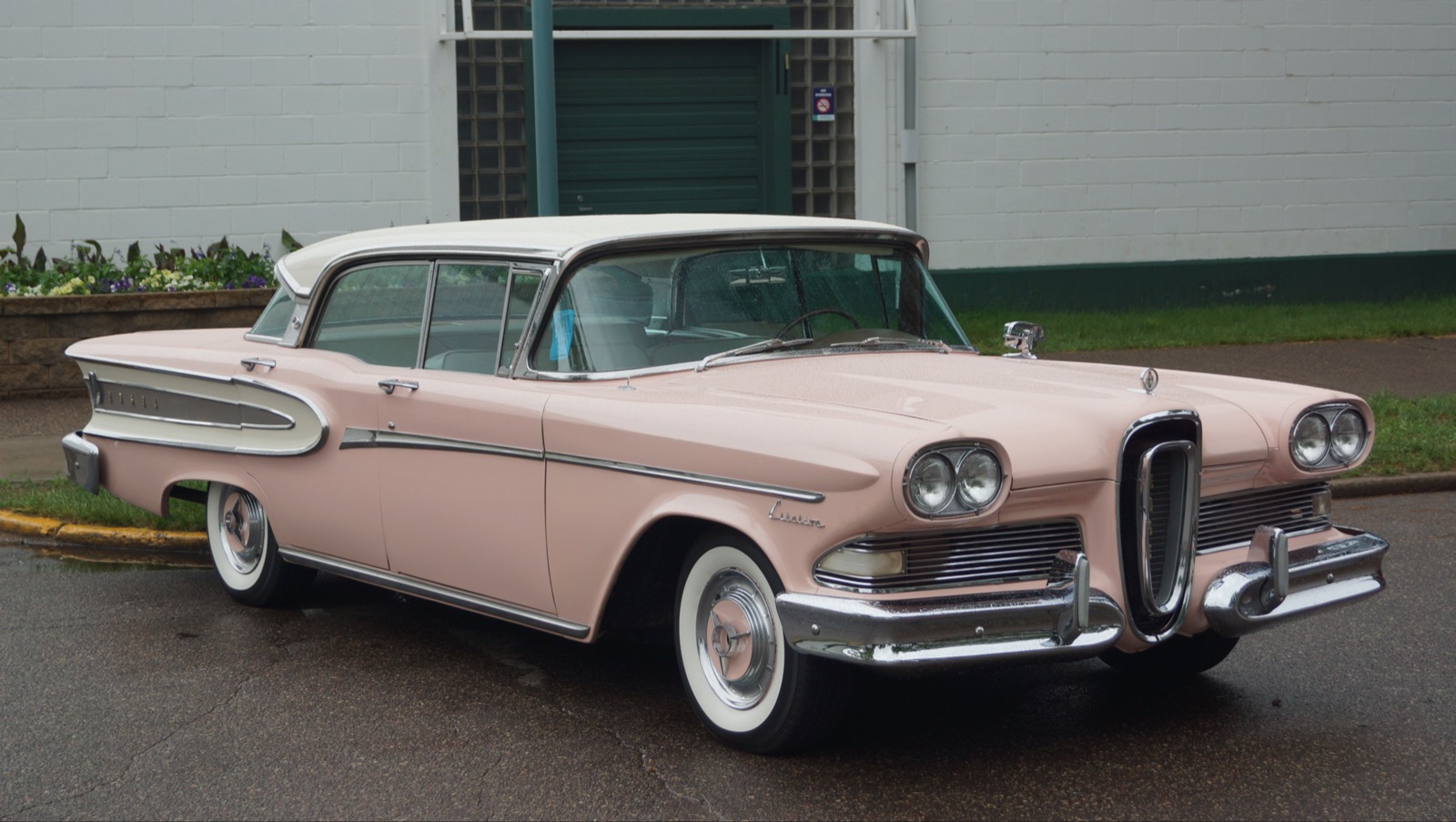
The Edsel was a medium-priced car that Ford Motor Company launched in September 1957 as a new make, with its own division and its own dealers.
Ford wanted a second car in that range because its customers, once they could afford more, usually traded up to a General Motors or Chrysler car rather than a Mercury, John Brooks wrote in The New Yorker in 1960. Lewis D. Crusoe, then a Ford vice-president, said, "We have been growing customers for General Motors."
The car was named for Edsel Ford, Henry Ford's only son and the father of Henry Ford II, the company's president.
Time reported that ten years of planning and $250 million had gone into it. The first Edsels came in 18 models, with engines of up to 345 horsepower and the transmission's push buttons in the center of the steering wheel.
Ford counted on selling at least 200,000 Edsels in the first year, Brooks wrote.
What happened
The Edsel reached showrooms about two years after its styling was finished and lasted 26 months once it got there.
In April 1955, Ford's executive committee set up a Special Products Division under Richard Krafve to build the new car, and its styling was done by that summer, Brooks wrote. Ford announced the name Edsel on November 19, 1956.
The market turned before launch. In July 1957 the stock market fell, and sales of medium-priced cars of all makes began to drop in early August, by Brooks's account.
The Edsel went on sale on Edsel Day, September 4, 1957. In the first ten days of October, deliveries averaged just over 300 a day, against the 600 to 700 Ford had calculated it needed to make a profit.
On January 14, 1958, Ford announced it was merging the Edsel and Lincoln-Mercury divisions into one Mercury-Edsel-Lincoln Division.
New Edsel registrations in 1958 came to 34,481, less than a fifth of the 200,000 a year Ford needed, Brooks reported. The 1959 models, out in November 1958, were smaller and cost $500 to $800 less. Ford brought out the 1960 Edsel in mid-October 1959, a little more than a month after its compact Falcon.
On November 19, 1959, a Ford Foundation stock prospectus listed the Edsel as discontinued, and Ford confirmed it the same day. Ford offered customers left with orphaned cars a $300 certificate toward another Ford product, Time reported.
By then Ford had built 110,810 Edsels, only 2,846 of them 1960 models, Brooks wrote. He cited outside estimates of a net loss of about $350 million.
Why it failed
Ford blamed falling demand for the Edsel, buyers' preference for its other cars and a steel shortage, and the Edsel's general manager and chief stylist blamed timing. Reporting and later analysis added a market moving to small cars, faulty early cars and prices that competed with Ford's own models.
What Ford said
Ford's announcement of November 19, 1959 cited "the severe decline in the demand for Edsel cars" and "high consumer preference for other company lines," and said continued production was not justified "especially in view of the shortage of steel." That's the text Ford quoted in a 2024 history piece, which adds that the cars arrived "at both the beginning of a recession and a steel shortage."
A Ford spokesman said the same day, Brooks reported, "If we knew the reason people aren't buying the Edsel, we'd probably have done something about it."
Former Edsel executives gave Brooks their own reasons in 1960. Krafve blamed his own bad timing, arguing the car would have done well had it come out in 1955 or 1956, when the medium-priced car market was riding high. Roy A. Brown, the Edsel's chief stylist, said styling had "very little, if anything, to do with its failure." J. C. Doyle, Krafve's second-in-command, called it "a buyers' strike."
What reporting showed
In March 1958, Time wrote that "the first real casualty of the current recession may well be the middle-priced automobile." Sales of middle-priced cars had fallen from 37% of the market in 1955 to 29% in 1957, Time reported, adding that "Ford's middle-priced Edsel, brought onto the market last year, is a flop."
Consumer Reports had already panned it. "The Edsel has no important basic advantages over other brands," the magazine wrote in January 1958, as Brooks later quoted it.
When Ford dropped the car, Time called it "a classic case of the wrong car for the wrong market at the wrong time." By 1957, Time wrote, "the bloom was gone from the medium-priced field," and a boom was starting in compact cars, "an area the Edsel research had overlooked completely."
What later analysis found
Brooks's two-part account in The New Yorker, published a year after the end, called the popular explanation, a car built to the orders of polls and motivational research, "largely a myth." The research was meant for advertising and "was not undertaken until after Brown had completed his design," he wrote.
Among the other factors, he pointed to the first cars off the line. "Edsels were delivered with oil leaks, sticking hoods, trunks that wouldn't open," Brooks wrote, and a former Edsel Division executive estimated that "only about half of the first Edsels really performed properly."
Diego Rosenberg wrote in Hagerty in 2020 that "the best research couldn't foresee the extent of the 1958 recession." But Ford priced the four Edsel series so they overlapped the Ford Fairlane 500 and three of the four Mercury models, he wrote, which "proved to be pure cannibalization."
The stage it reached
The Edsel never left the introduction stage, which the product life cycle guide describes as the launch period, when awareness is low and sales are small.
Its best stretch, in early summer 1959, came to almost a quarter of the rate Ford needed to make a profit, by Brooks's figures.
Prices moved within months, a mark of the stage. In December 1957 the Edsel Division let dealers take $100 to $300 off each car without losing margin.
It never reached growth, so I count it as a failure, not a decline.
Like the Tata Nano, it was sized for far more buyers than turned up.
The lesson
I think the Edsel's real problem was the calendar. Brooks called the time lag between deciding to build it and putting it on sale "one of the most persuasive and most frequently cited explanations" of the failure, and Krafve blamed it himself.
A long build locks in the market you saw at the start. If yours takes two years, re-test the assumption your plan rests on at every gate. For the Edsel, that assumption was that buyers would keep trading up to bigger medium-priced cars.
Then size the launch to what you know. Ford set up a division and nearly 1,200 dealers for 200,000 sales a year, Brooks wrote, before the first buyer had paid.
Causes at a glance
Company statementTiming
Ford said it arrived at the start of a recession and a steel shortage
Company statementWeak demand
Ford cited a severe decline in demand and buyers' preference for its other cars
Reporting at the timeUnclear value
Consumer Reports found no important basic advantages over other brands
Later analysisQuality and reliability
Many early cars had oil leaks, sticking hoods and trunks that wouldn't open
Source6
Later analysisCompetition
Its prices overlapped the Ford Fairlane 500 and most Mercury models
Source7
Sources
- 1.Ford Motor Company, TBT: How the Unsuccessful Edsel Led Ford to Create the Mustang
November 2024 · Company statement
- 2.Time, AUTOS: The Newest Car
September 1957 · Reporting at the time
- 3.Time, AUTO PRESTIGE: Conspicuous Consumption Is Waning
March 1958 · Reporting at the time
- 4.Time, AUTOS: The $250 Million Flop
November 1959 · Reporting at the time
- 5.The New Yorker (John Brooks), The Edsel - I: The E-Car Has Faith in You, Son
November 1960 · Later analysis
- 6.The New Yorker (John Brooks), The Edsel - II: Epitome
December 1960 · Later analysis
- 7.Hagerty (Diego Rosenberg), How the 1958 economic recession put Edsel and DeSoto over the edge
June 2020 · Later analysis
More from the graveyard
2019
Tata Nano
Tata Motors Personal transport
Tata Motors built no Nanos in 2019 and never formally announced the end
2002
New Coke
The Coca-Cola Company Food and drink
The original returned as Coca-Cola Classic on July 11, 1985; New Coke, renamed Coke II, was sold until 2002
Jul 2020
Segway PT
Segway Personal transport
Segway retired the PT and ended its US production on July 15, 2020