Marketplaces and commerce · AI · OCT 1, 2026 · 7 MIN READ
Amazon Go

- Company
- Amazon
- Category
- Marketplaces and commerce
- Launched
- January 2018
- Ended
- 2026
- Stage reached
- Introduction
- AI product
- Yes
- Status
- Amazon said most Go stores would close February 1, 2026, and its California stores later
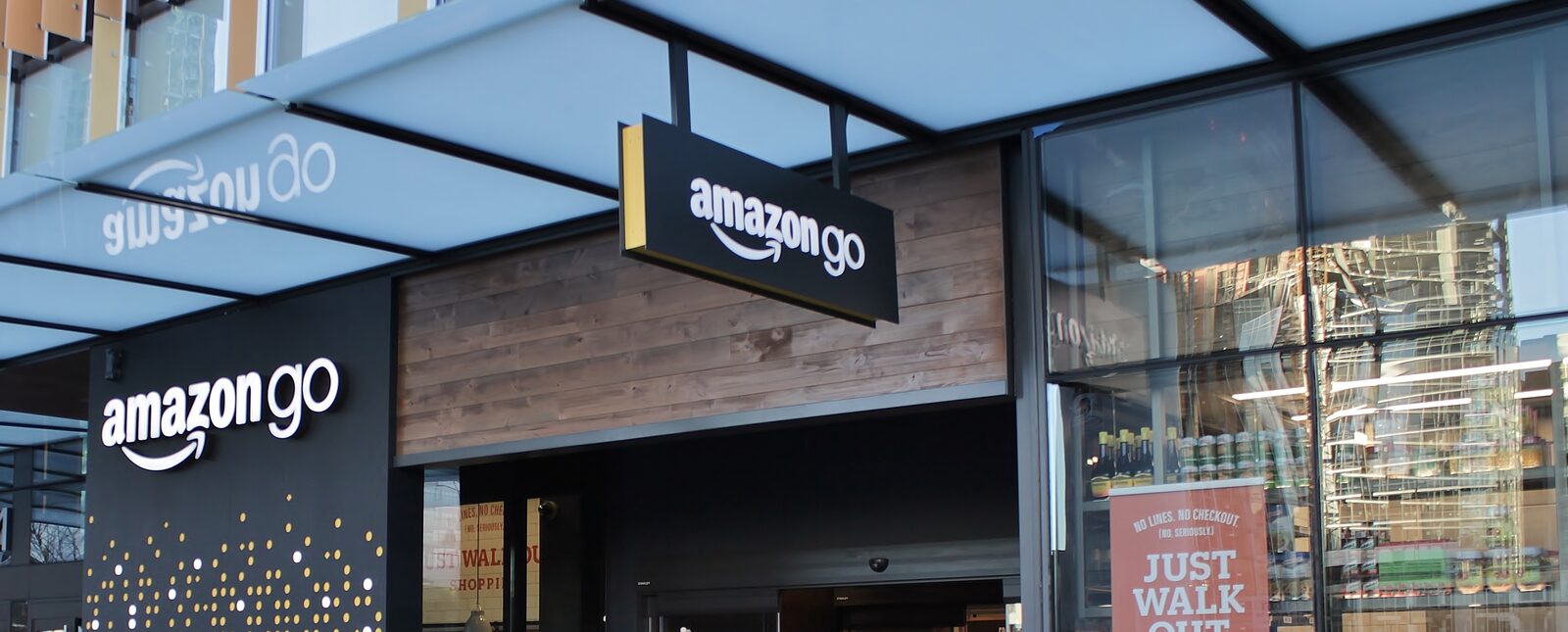
Amazon Go was Amazon's chain of checkout-free convenience stores. It opened to the public in Seattle in January 2018, peaked at about 30 stores, and Amazon closed it in 2026.
What it was
Each Amazon Go store used cameras and sensors to work out what shoppers took, and charged them when they walked out.
Shoppers scanned the Amazon Go app at a turnstile to get in, AP reported at the opening. Anything they took off a shelf went into a virtual cart, and anything they put back came out of it.
Amazon called it Just Walk Out shopping. Jeff Bezos wrote in his 2017 letter to shareholders that it ran on "a custom-built combination of computer vision, sensor fusion, and deep learning".
Bloomberg later described the first store as one near Amazon's headquarters, selling salads, sandwiches and snacks to office workers who wanted a meal on the run.
What happened
Amazon Go took more than a year to open to the public after it was announced.
AP reported that Amazon announced the store in December 2016 and said it would open by early 2017, then delayed the debut while it worked on the technology and its employees tested it. Go opened to the public on January 22, 2018.
In September 2018, Bloomberg reported, citing people familiar with the plans, that Amazon was considering as many as 3,000 Go stores by 2021. Amazon declined to comment.
The chain peaked at about 30 stores in early 2023, Retail Dive reported. Bloomberg reported in March 2023 that Amazon was closing eight of them, and three New York stores followed in 2024. By January 2025 Amazon had 16 Go stores, a spokesperson told Retail Dive.
In April 2024, as Amazon was rolling back Just Walk Out in its US grocery stores, Fortune asked Dilip Kumar, an Amazon vice president and one of its inventors, about a report that humans were involved in 700 of every 1,000 Just Walk Out sessions in 2022. Kumar said "that sounds high", that humans review "a small sample of videos", and "We don't share those numbers."
On January 27, 2026, Amazon said it would close all its Go stores and its Amazon Fresh grocery stores. AP counted 15 Go stores still open, Bloomberg 14.
Amazon said the last day would be February 1, AP reported, except in California, where stores would stay open longer to comply with state requirements. The Orange County Register later reported that the remaining California Fresh and Go stores would close on March 13, 2026.
Why it failed
Amazon said it hadn't yet built a distinctive enough store with an economic model that could scale, while reporters pointed to the cost of opening each location, ordinary merchandise and an office-lunch trade that remote work cut.
What Amazon said
In its closure post, Amazon wrote that "we haven't yet created a truly distinctive customer experience with the right economic model needed for large-scale expansion." It was closing the stores "to prioritize investment in growth areas", and planning to open more than 100 new Whole Foods Market stores over the next few years.
Jason Buechel, Amazon's vice president of worldwide grocery and the CEO of Whole Foods, gave staff the same reason in a memo CNBC printed.
The post doesn't blame the Just Walk Out technology. It calls the Go stores "innovation hubs" where Amazon developed it, and says the technology runs in more than 360 third-party locations across five countries.
On the call for the fourth quarter of 2022, CFO Brian Olsavsky said Amazon had decided "to exit certain stores with low growth potential." Grocery Dive reported that he said Fresh and Go accounted for the bulk of a $720 million impairment charge that quarter.
A spokesperson told Bloomberg in 2023 that Amazon remained "committed to the Amazon Go format". Three New York stores "were performing well", Amazon told C-Store Dive in 2024, but "we couldn't make the economics work with the lease cost". In January 2025 a spokesperson told Retail Dive that Amazon would keep investing in its Go stores.
What reporting showed
Bloomberg reported in 2018 that the first store "required more than $1 million in hardware alone", according to a person familiar with the matter, and called the high cost of opening each location the challenge to Amazon's plan. In the same story, NACS vice president Jeff Lenard said that if a store is a quarter mile from where people walk and bike, "the novelty of the technology won't matter."
Bloomberg wrote in 2023 that the format "was a victim of the pandemic", because so many people worked from home and went to the office only a few days a week. Amazon's statements on the 2023 and 2026 closures don't mention the pandemic.
At the closure, Fortune's Phil Wahba wrote that "the dazzling tech was not enough to camouflage how blah the merchandise was." Fortune quoted Neil Saunders, managing director at GlobalData, saying neither Fresh nor Go offered an appealing in-store experience. In emailed comments quoted by Bloomberg, he said neither was "delivering the sales needed to make them fully economic".
What later analysis found
C-Store Dive argued, the day after the announcement, that Amazon built a convenience chain without fuel, which it called "the primary driver of visits to c-stores in the U.S." It said fuel wasn't the only reason, and that it's possible Amazon "never gave customers a reason to visit its convenience stores in the first place."
In an opinion column for Computerworld, Evan Schuman wrote that shoppers "visited Go mostly for the novelty" and didn't find it meaningfully better than their usual stores. He wrote that Amazon didn't drop the technology; it "realized that the value of the technology lay elsewhere."
The stage it reached
Amazon Go never left the introduction stage. I found no published figure for Go's sales, so this call rests on store counts, costs and Amazon's own words.
In the product life cycle, growth is when adoption accelerates and unit costs fall as volume builds. Go never got near the scale Bloomberg's sources described, and no source I read reports its costs falling. I read Amazon's 2026 statement, that it hadn't yet found the right economic model needed for large-scale expansion, as an introduction-stage verdict.
It wasn't a decline either. Decline is when sales fall because the market has moved on to a substitute. Amazon's closure post says US shoppers are "turning to online delivery", but that's a claim about shoppers in general, not evidence about Go's customers.
The lesson
I think Go shows that a better way to pay isn't a reason to visit.
Bezos said in 2018 that Amazon was "very interested" in physical stores, but only with something new to offer. "If we offer a me-too product, it's not going to work," he said, Bloomberg reported. Go's checkout was new. By Fortune's account, its shelves weren't.
Go looks to me like a store built outward from its technology instead of from the shopper, the first pattern in why AI projects fail.
If you're building a product around a clever model, count repeat visits apart from first visits, and work out what one location costs and earns before you plan the next ten.
Causes at a glance
Company statement · Business model and costs
Amazon said it hadn't yet found the economic model needed for large-scale expansion
Reporting at the time · Unclear value
Fortune said the technology couldn't hide how ordinary the merchandise was
Source 16
Reporting at the time · Timing
Bloomberg said remote work after the pandemic cut its office-lunch trade
Source 6
Company statement · Change of company strategy
Amazon said it was closing Go to prioritize investment in growth areas and Whole Foods
Source 11
Sources
- 1.AP (via HeraldNet), Amazon opens store with no cashiers, lines or registers
January 2018 · Reporting at the time
- 2.The Next Web, Amazon's cashier-less grocery store opens to the public today
January 2018 · Reporting at the time
- 3.Amazon, 2017 Letter to Shareholders
April 2018 · Company statement
- 4.Bloomberg, Amazon Said to Plan Up to 3,000 Cashierless Stores by 2021
September 2018 · Reporting at the time
- 5.Grocery Dive, Amazon Fresh store expansion paused as it seeks better differentiation, economics
February 2023 · Reporting at the time
- 6.Fortune (Bloomberg), Amazon's cost-cutting binge claims another casualty: Self-checkout stores in 3 cities
March 2023 · Reporting at the time
- 7.Supermarket News, Amazon to close 8 of its cashierless convenience stores
March 2023 · Reporting at the time
- 8.Fortune, Amazon's co-inventor of 'Just Walk Out' tech - which is being removed from U.S. grocery stores - sets the record straight on the 'overblown' theory of its demise
April 2024 · Reporting at the time
- 9.C-Store Dive, 3 Amazon Go stores close
October 2024 · Reporting at the time
- 10.Retail Dive, Another Amazon Go will close next month
January 2025 · Reporting at the time
- 11.Amazon, Amazon to close Fresh, Go stores, expanding Whole Foods
January 2026 · Company statement
- 12.AP (via Spectrum News 13), Amazon to close Amazon Go and Amazon Fresh to concentrate on Whole Foods and grocery delivery
January 2026 · Reporting at the time
- 13.CNBC, Read the memo: Amazon's grocery boss details restructuring, says more 'deliberate' strategy needed
January 2026 · Company statement
- 14.Los Angeles Daily News (Bloomberg), All Amazon Fresh and Go convenience stores closing
January 2026 · Reporting at the time
- 15.C-Store Dive, Amazon Go's demise exposes a hard truth: Fuel-less c-stores aren't working
January 2026 · Later analysis
- 16.Fortune, Amazon is closing its futuristic Go and Fresh stores - showing logistics and tech aren't enough to make old-school retail work
January 2026 · Reporting at the time
- 17.Computerworld, Amazon Go? It's gone. And this is why it went.
February 2026 · Later analysis
- 18.Orange County Register, Amazon cutting 3,339 jobs at Southern California convenience stores
February 2026 · Reporting at the time
More from the graveyard
Aug 2015
Amazon Fire Phone
Amazon · Phones
Amazon ceased sales in August 2015, when the phone sold out
Feb 2025
Humane AI Pin
Humane · Wearables · AI
Sales ended February 18, 2025; Humane said the Pins would go offline February 28, 2025
Dec 2024
Cruise robotaxi service
Cruise (General Motors) · Personal transport · AI
GM said on December 10, 2024 that it would stop funding Cruise's robotaxi development
Jul 2020
Segway PT
Segway · Personal transport
Segway retired the PT and ended its US production on July 15, 2020