Personal transport · AI · OCT 21, 2026 · 8 MIN READ
Cruise robotaxi service

- Company
- Cruise (General Motors)
- Category
- Personal transport
- Launched
- June 2022
- Ended
- December 2024
- Stage reached
- Introduction
- AI product
- Yes
- Status
- GM said on December 10, 2024 that it would stop funding Cruise's robotaxi development
Cruise, a General Motors subsidiary, started charging for driverless taxi rides in San Francisco in June 2022. California suspended its permits 16 months later, after one of its cars dragged a pedestrian, and in December 2024 GM said it would stop funding robotaxi development.
What it was
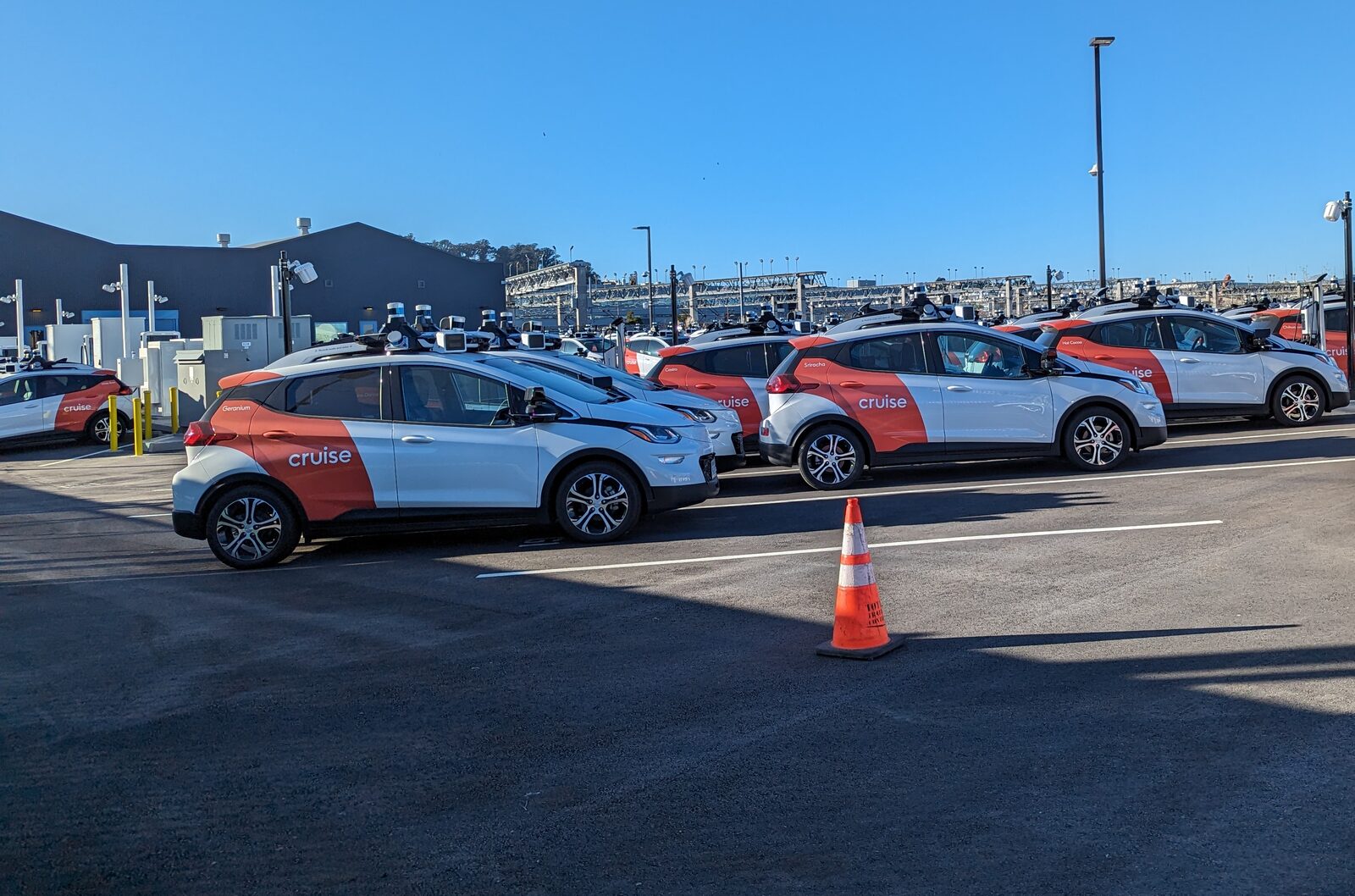
Cruise's robotaxi service was a ride-hail app that sent self-driving Chevrolet Bolts, with no driver in the car, to carry passengers in San Francisco and later other US cities.
Founded in San Francisco in 2013, Cruise was acquired by GM in 2016.
On June 2, 2022, the California Public Utilities Commission (CPUC) issued Cruise the state's first driverless passenger deployment permit. It covered 30 cars on select San Francisco streets from 10 p.m. to 6 a.m., and it let Cruise collect fares.
Kyle Vogt, Cruise's co-founder, posted on June 23 that Cruise had collected its first fares from driverless rides the night before, Wednesday, June 22. Riders got in with an invite code from the public waitlist, The Verge reported.
What happened
Cruise's paid service ran until October 2023, when California suspended its permits after a crash and Cruise paused its driverless rides everywhere.
On August 10, 2023, the CPUC let Cruise and Waymo charge fares in San Francisco at any time of day. A week later a Cruise car collided with a fire truck, and California's Department of Motor Vehicles (DMV) asked Cruise to halve its active fleet while it investigated.
By late October, Cruise had started driverless operations in San Francisco, Austin, Phoenix, Houston, Dallas and Miami.
On October 2, 2023, a human-driven car threw a pedestrian into the path of a driverless Cruise car, which ran over her and stopped. The car didn't detect that she was underneath it, so it tried to pull over and dragged her more than 20 feet, the US Attorney's Office later said.
On October 24 the DMV suspended Cruise's driverless permits, effective immediately. Two days later Cruise paused driverless operations across all its fleets, and CNBC reported that the CPUC had also suspended its permit to carry paying passengers.
Vogt resigned on November 19. In December, Cruise dismissed nine leaders over its response to the crash and said it would cut 900 jobs, 24% of its workforce, CNBC reported.
GM gave Cruise $850 million in June 2024 to restart testing in three cities, and Cruise signed a deal to offer rides on Uber in 2025, TechCrunch reported.
In September 2024, Cruise agreed to a $1.5 million penalty from the National Highway Traffic Safety Administration (NHTSA) over its failure to fully report the crash. It admitted in November that it had submitted a false report to influence a federal investigation, and agreed to pay a $500,000 criminal fine.
On December 10, 2024, GM said it would no longer fund Cruise's robotaxi development. It took full ownership on February 4, 2025, and said Cruise would work on self-driving and driver assistance technology for personal vehicles. The same day, TechCrunch reported that Cruise was laying off nearly half its staff.
Why it failed
Cruise lost its California permits over its cars' safety and what it told regulators about the crash, and GM said it was quitting because of the time and money scaling would take in an increasingly competitive market.
What Cruise and GM said
GM's December 2024 release said it would stop funding the work "given the considerable time and resources that would be needed to scale the business, along with an increasingly competitive robotaxi market." It doesn't mention the crash or the suspension.
On that day's analyst call, CEO Mary Barra said the cost of running a robotaxi fleet was "fairly significant" and "not our core business," CNBC reported. She said GM had already invested $10 billion, according to WardsAuto. CNBC also reported that CFO Paul Jacobson put GM's spending on Cruise at about $2 billion a year.
Cruise's account of the suspension came from Quinn Emanuel, the law firm it retained, and Cruise said it "accepts Quinn Emanuel's conclusions." The January 2024 report called the suspension the result of "a proverbial self-inflicted wound" by certain senior leaders and employees. It blamed "poor leadership, mistakes in judgment, lack of coordination" and an "us versus them" mentality with regulators.
The report said the evidence it had reviewed to date didn't establish that anyone at Cruise set out to mislead regulators. When California suspended the permits in October 2023, Cruise denied in a statement to the Los Angeles Times that it hadn't shared all its video with investigators.
Exponent, the engineering firm Cruise hired to analyze the crash, found the car had wrongly decided it was in a side collision, so it pulled over instead of making an emergency stop.
I found no Cruise statement saying it had moved too fast. Its December 2023 layoff memo called the new plan, a relaunch in one city, "very different from our prior plans to expand into more than a dozen new cities in 2024."
What reporting showed
California's DMV listed among its grounds that Cruise's vehicles were "not safe for the public's operation" and that Cruise had misrepresented information about the safety of its technology.
According to the Los Angeles Times, the suspension order said Cruise first showed state officials only the first part of the crash video, without the dragging.
The US Attorney's Office later said Cruise's first reports to NHTSA left the dragging out. Staff tried to show NHTSA the video in a call, but the dragging "did not play" because of technical difficulties. Cruise sent the video that day and didn't correct its reports.
Philip Koopman, a Carnegie Mellon safety researcher, told CNBC in October 2023 that "Cruise has not done such safety stand downs voluntarily," and that the DMV had forced them twice.
In November 2023, The New York Times reported that company insiders blamed a tech industry culture, led by Vogt, that put the speed of the program ahead of safety.
When GM announced its exit, CNBC wrote, "As Cruise's operations were on hold, its robotaxi rivals gained ground."
What later analysis found
"Arguably this communication mistake (rather than the mishap itself) was the main reason Cruise operations eventually had to be shut down," Koopman wrote in a 2024 paper on the crash.
He also wrote that removing the safety supervisor "seems motivated by business and publicity interests rather than a primary focus on safety," and that numerous incidents of emergency responder interference had been ample warning that the supervisors came out too early. His paper advises readers to assume the Quinn Emanuel and Exponent reports were crafted to present "the most favorable picture possible" toward Cruise's stated goal of regaining trust. It came out before GM's exit.
Looking back in April 2026, ABC7 San Francisco wrote that while Waymo moved with caution, Cruise "charged ahead with a Silicon Valley-style blitz."
The stage it reached
Cruise's robotaxi service never left the introduction stage of the product life cycle, when few people outside the early adopters have tried a product.
Access stayed gated. Cruise was still operating with a waitlist in August 2023, CNBC reported, and its fleet had grown from the 30 cars in its June 2022 CPUC permit to 400 when driverless operations stopped, according to the New York Times.
Vogt's resignation email put Cruise's lifetime total at over 250,000 driverless rides.
Competition wasn't thin, as it usually is at this stage. Waymo won the same all-day fare approval on the same day, and by September 2026 it was in the growth stage.
GM said in 2021 that Cruise had the potential to deliver $50 billion in revenue a year by the end of the decade. Two years later, the Times reported a revenue goal of $1 billion in 2025, about half of what Jacobson later said GM was spending on Cruise each year.
Like the Humane AI Pin, it never reached decline. I found no report of riders drifting away before the rides stopped in October 2023.
The lesson
I think Cruise lost its permits more over what it did after the crash than over the crash itself. In the first two days, Quinn Emanuel found, its leaders were "fixated on correcting the inaccurate media narrative" that blamed their car.
When your product runs on a regulator's permission, the regulator comes before the press. Give regulators the whole story the first time, including the part that makes you look worst.
I'd take Koopman's point about the safety supervisor to any AI product that acts on its own. Keep the human check until the product has shown it can handle the rare, ugly case, and treat each near miss as a sign it can't yet. It's the same reason I'd start a first AI build with human review on every output.
Causes at a glance
Reporting at the time · Privacy and safety
A driverless car dragged a pedestrian, and California called the cars unsafe
Company statement · Regulation
A report Cruise accepted blamed its handling of regulators for the suspension
Company statement · Business model and costs
GM cited the time and money needed to scale a robotaxi business
Later analysis · Rushed launch
Koopman says removing safety supervisors seems driven by business more than safety
Company statement · Competition
GM cited an increasingly competitive robotaxi market
Sources
- 1.General Motors, GM Details Plan to Double its Revenue, Drive Even Higher Margins
October 2021 · Company statement
- 2.California Public Utilities Commission, CPUC Issues First Driverless Autonomous Vehicle Passenger Service Deployment Permit
June 2022 · Reporting at the time
- 3.The Verge, Cruise is now charging for rides in its driverless vehicles in San Francisco
June 2022 · Reporting at the time
- 4.The Robot Report, Cruise hits milestone by charging for robotaxis rides
June 2022 · Reporting at the time
- 5.California Public Utilities Commission, CPUC Approves Permits for Cruise and Waymo To Charge Fares for Passenger Service in San Francisco
August 2023 · Reporting at the time
- 6.CNBC, Cruise will reduce robotaxi fleet by 50% in San Francisco while California DMV investigates 'incidents'
August 2023 · Reporting at the time
- 7.California DMV, DMV Statement on Cruise LLC Suspension
October 2023 · Reporting at the time
- 8.CNBC, California DMV suspends Cruise's self-driving car permits, effective immediately
October 2023 · Reporting at the time
- 9.Los Angeles Times, California DMV pulls permits for Cruise's driverless cars over safety concerns
October 2023 · Reporting at the time
- 10.CNBC, Cruise pauses all driverless operations after collisions with pedestrians, permit suspensions in California
October 2023 · Reporting at the time
- 11.The New York Times, G.M.'s Cruise Moved Fast in the Driverless Race. It Got Ugly.
November 2023 · Reporting at the time
- 12.TechCrunch, Cruise co-founder and CEO Kyle Vogt resigns
November 2023 · Reporting at the time
- 13.CNBC, GM's Cruise laying off 900 employees, or 24% of its workforce: Read the memo here
December 2023 · Reporting at the time
- 14.Quinn Emanuel, for the boards of Cruise and GM, Report to the Boards of Directors of Cruise LLC, GM Cruise Holdings LLC, and General Motors Holdings LLC regarding the October 2, 2023 accident in San Francisco
January 2024 · Company statement
- 15.Cruise, Cruise Releases Third-Party Findings Regarding October 2
January 2024 · Company statement
- 16.Philip Koopman, arXiv, Anatomy of a Robotaxi Crash: Lessons from the Cruise Pedestrian Dragging Mishap
February 2024 · Later analysis
- 17.NHTSA, NHTSA Announces Consent Order with Cruise After Company Failed to Fully Report Crash Involving Pedestrian
September 2024 · Reporting at the time
- 18.US Attorney's Office, Northern District of California, Cruise Admits To Submitting A False Report To Influence A Federal Investigation And Agrees To Pay $500,000
November 2024 · Reporting at the time
- 19.General Motors, GM to refocus autonomous driving development on personal vehicles
December 2024 · Company statement
- 20.CNBC, GM exits robotaxi market, will bring Cruise operations in house
December 2024 · Reporting at the time
- 21.TechCrunch, Cruise employees 'blindsided' by GM's plan to end robotaxi program
December 2024 · Reporting at the time
- 22.CNBC, via NBC News, GM's Cruise robotaxi business is latest growth initiative to falter
December 2024 · Reporting at the time
- 23.General Motors, GM acquires full ownership of Cruise
February 2025 · Company statement
- 24.TechCrunch, Cruise to slash workforce by nearly 50% after GM cuts funding to robotaxi operations
February 2025 · Reporting at the time
- 25.WardsAuto, GM shuts troubled Cruise robotaxi unit
December 2024 · Reporting at the time
- 26.ABC7 San Francisco, via Yahoo Finance, How GM's Cruise robotaxi bet derailed, turned into industry cautionary tale
April 2026 · Later analysis
More from the graveyard
Feb 2025
Humane AI Pin
Humane · Wearables · AI
Sales ended February 18, 2025; Humane said the Pins would go offline February 28, 2025
Mar 2016
Tay
Microsoft · Assistants and chatbots · AI
Taken offline after about 16 hours; a brief return ended on March 30, 2016
2026
Amazon Go
Amazon · Marketplaces and commerce · AI
Amazon said most Go stores would close February 1, 2026, and its California stores later
Apr 2026
Sora app
OpenAI · Social networks · AI
The app and web version were discontinued on April 26, 2026, and the API on September 24, 2026