Games and consoles NOV 7, 2026 6 MIN READ
Virtual Boy
My post on failed products examples covers twelve famous cases from tech and why each one failed.



The timeline as text
- November 14, 1994Nintendo announces it and projects 3 million sales in Japan
- July 21, 1995Goes on sale in Japan
- August 1995Goes on sale in the US at $179.95
- October 18, 1995US price cut to $159.95
- December 22, 1995Nintendo pulls it in Japan
- May 1996US price cut to $99
- August 1996Nintendo pulls the plug for good
- January 2011Iwata calls it a commercial failure in Iwata Asks
- September 12, 2025Nintendo announces Virtual Boy games for Switch Online
- Company
- Nintendo
- Category
- Games and consoles
- Launched
- July 1995
- Ended
- August 1996
- Stage reached
- Introduction
- AI product
- No
- Status
- Nintendo dropped it in Japan in December 1995 and for good in August 1996
The Virtual Boy failed because it was a red-only 3D console you hunched over at a table, rushed out ahead of the Nintendo 64 and, by Nintendo's own later account, sold as a full platform when it was a niche toy. Nintendo dropped it about a year after launch, with an estimated 770,000 sold.
What it was
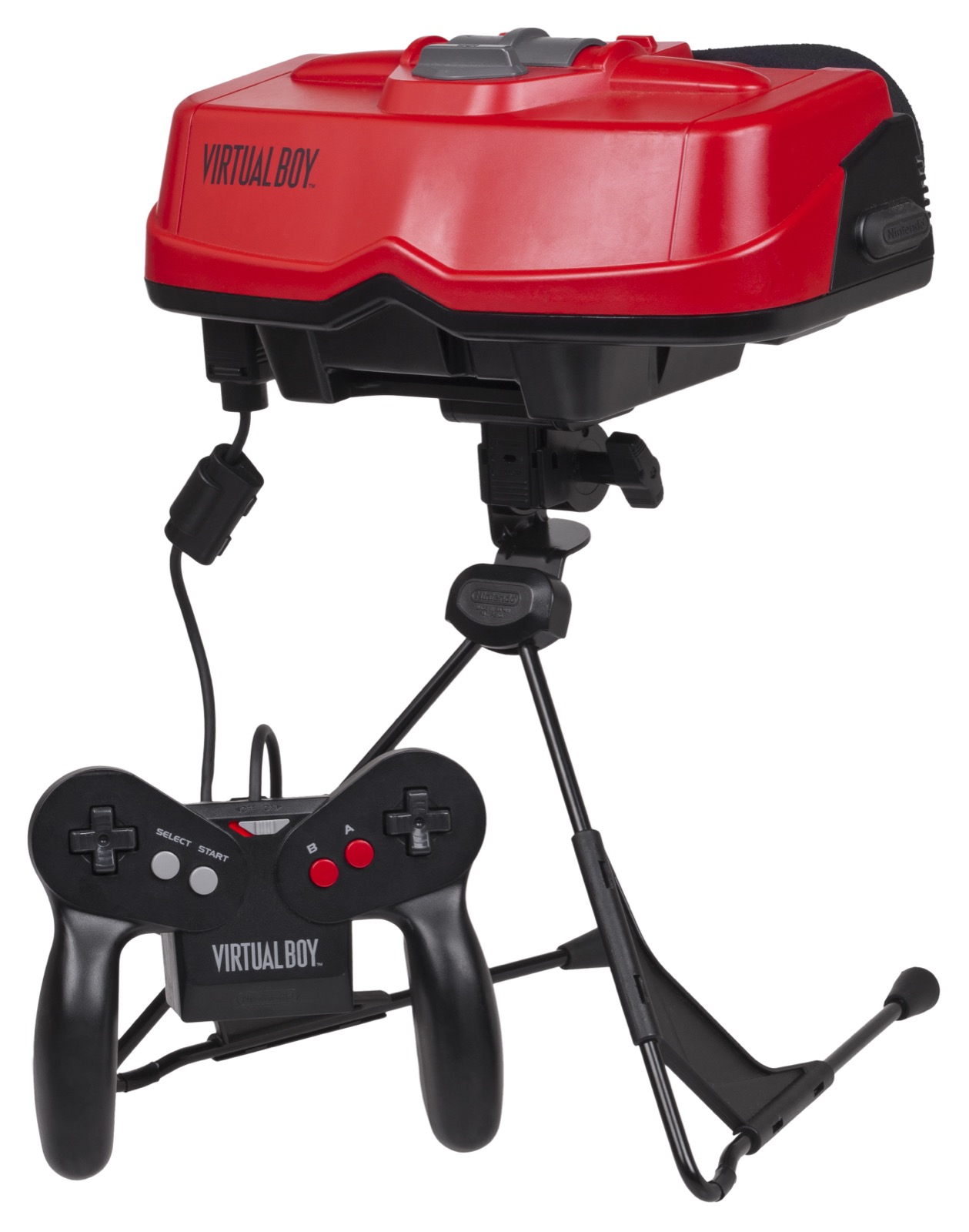
The Virtual Boy was a Nintendo game console that showed 3D games in red and black through an eyepiece on a stand.
You looked into two miniature displays built from red LEDs, The New York Times reported on November 14, 1994, and the system was "designed to be used while seated at a table." Nintendo's announcement that day called it "the first virtual reality system developed and produced for the mass market."
Gunpei Yokoi, head of Nintendo's R&D1 division and, in Satoru Iwata's words, "the father of Game Boy," led the project. Nintendo licensed the display technology from Reflection Technology, a small Massachusetts company.
It began as a headset. Yokoi's biographer Takefumi Makino told Fast Company that a metal plate added to shield the player's head from the chip "made the whole system too heavy, forcing the goggle concept to be abandoned."
What shipped instead was "a bulky red viewport mounted to a bi-pod that rested on a table," Fast Company wrote.
What happened
The Virtual Boy went on sale in Japan on July 21, 1995, according to Seeing Red, a history of the console by Jose Zagal and Benj Edwards that Ars Technica excerpted in 2024. It reached the United States that August at $179.95, Reuters reported.
Nintendo of America cut the price to $159.95 on October 18, 1995, the book says.
In Japan, Nintendo pulled it on December 22, 1995, Seeing Red says. The US price fell to $99 in May 1996, and in August 1996, Fast Company wrote, Nintendo "officially pulled the plug once and for all."
Steven Boyer wrote in a 2009 academic paper that Nintendo let the system disappear "without any formal announcement." About 13,000 people bought one in December 1996, Next Generation reported.
Seeing Red estimates 770,000 sold in all, 140,000 of them in Japan and 630,000 in North America.
In September 2025, Nintendo announced that Virtual Boy games would come to Nintendo Switch Online on February 17, 2026, in the US and Canada, played through an add-on accessory, either a cardboard model or what it called "a replica of the original hardware."
Why it failed
Nintendo's Shigeru Miyamoto later blamed how the company sold the Virtual Boy. Reporting at the time pointed at the hardware, and later histories add the pressure of the coming Nintendo 64.
What Nintendo said
I found no statement from Nintendo explaining the end. In December 1995, with reviews mixed, Nintendo said new games would help sales, The New York Times reported.
Nintendo's own account came in a January 2011 Iwata Asks interview about the 3DS. "Virtual Boy was, I think, a commercial failure," said Satoru Iwata, then Nintendo's president. Its red-and-black visuals "were at a bit of a disadvantage" as game graphics got richer, he said.
Shigeru Miyamoto, who said he wasn't a central player on it, blamed positioning. He saw "a fun toy," but "the world treated it like a successor to the Game Boy system." So did Nintendo's sales department, he said, treating it as an extension of the company's licensing business.
"When you think of it as a gaming platform, it becomes a failure," he said. He also named "how it looked when you played" as "another big problem," with the player "peering into the Virtual Boy" the whole time.
Later in the conversation he said, "It's not so much that the machine itself was wrong as a product, but that we were wrong in how we portrayed it."
What reporting showed
When Nintendo announced it, The New York Times noted that the display showed "only shades of red against a black background."
Reviewing it for the Los Angeles Times in August 1995, Aaron Curtiss called the display "top drawer" but found the hardware "odd and somewhat cumbersome."
It was "impossible to play Virtual Boy casually on the couch," he wrote, because it "requires full attention and the use of a table."
Curtiss noted that Nintendo advised young children not to play it and recommended frequent breaks to avoid eye strain.
What later analysis found
In 2015, Benj Edwards wrote in Fast Company that Nintendo's president, Hiroshi Yamauchi, encouraged Yokoi's team to ready the Virtual Boy "as soon as possible to buy time prior to the launch of the Nintendo 64." Yokoi was also told to de-emphasize Mario, he wrote, because Mario's big 3D debut was saved for the Nintendo 64.
Edwards wrote that Japan's press sensationalized Nintendo's health and eyesight warnings before the launch there. In his 1997 autobiography, as Fast Company quoted it, Yokoi wrote that buyers who read the warnings, knowing nothing of Japan's new product liability law, got "the image that this product was bad for your health."
Yokoi blamed Nintendo's marketing in Japan above all, Fast Company wrote. "Give me one billion yen to market it, and I will launch the Virtual Boy into the stratosphere," he said he told colleagues.
Boyer's paper in The Velvet Light Trap pointed to price. Paying $180 for "a system that was not completely portable or as fully featured as the next-generation systems" didn't seem logical to many consumers, he wrote.
Seeing Red says the most credible explanations for the quick end are "a lack of potential games that could turn sales around" and the crisis around the delayed Nintendo 64. By that argument, Nintendo cut its losses "to increase the chances of the N64 succeeding."
The stage it reached
The Virtual Boy died in the introduction stage, the launch period when, as the product life cycle guide puts it, awareness is low and sales are small.
Prices moved twice within a year in the US, from $179.95 to $159.95 and then $99, a mark of the stage.
It never reached growth. Japan took about 140,000, against the 3 million Nintendo's announcement had projected by March 1996, so I count it as a failure, not a decline.
3D TV brought 3D to selected TV sets from 2010, with glasses instead of an eyepiece, and never left the same stage either.
The lesson
I think the Virtual Boy's biggest mistake was the scorecard Nintendo picked for it.
Miyamoto said that "if you think of it as just a fun toy, it's a big success if you break just 50,000." Nintendo projected 3 million in Japan alone. The name, Fast Company wrote, "set up inevitable comparisons" with the Game Boy.
If you're launching something odd, decide in writing whether it's an experiment or a platform. Then make the forecast, the name and the price agree with that answer.
Nintendo kept working on 3D anyway. In the same 2011 interview, Iwata said, "you could say that those attempts have now finally borne fruit."
Causes at a glance
Company statementUnclear value
Miyamoto said Nintendo sold a niche toy as a full platform and Game Boy successor
Source8
Reporting at the timeQuality and reliability
A red-only display on hardware that needed a table, not the couch
Later analysisRushed launch
Pushed out early to buy time before the Nintendo 64, with Mario held back
Source9
Later analysisPrivacy and safety
Health warnings, played up by Japan's press, made it look bad for your eyes
Later analysisPricing
$180 for a console neither fully portable nor as fully featured as next-generation ones
Source7
Later analysisMissing apps, content or partners
Too few games that could turn sales around, a reason Seeing Red finds credible
Source10
Sources
- 1.Nintendo (Business Wire), Nintendo introduces video game players to three-dimensional worlds with new virtual reality video game system
November 1994 · Company statement
- 2.The New York Times, Nintendo Counts on a New 'Virtual' Game
November 1994 · Reporting at the time
- 3.The New York Times (Reuters), Introduction by Nintendo
August 1995 · Reporting at the time
- 4.Los Angeles Times, Virtual Boy a Blend of Familiar and Strange
August 1995 · Reporting at the time
- 5.The New York Times, A Crowded Field: Portable Video Games
December 1995 · Reporting at the time
- 6.Next Generation, Life In The Old Dogs Yet?
February 1997 · Reporting at the time
- 7.The Velvet Light Trap, A Virtual Failure: Evaluating the Success of Nintendo's Virtual Boy
2009 · Later analysis
- 8.Nintendo (Iwata Asks), Iwata Asks: Nintendo 3DS, Shigeru Miyamoto Talks Virtual Boy
January 2011 · Company statement
- 9.Fast Company, Unraveling The Enigma Of Nintendo's Virtual Boy, 20 Years Later
August 2015 · Later analysis
- 10.Ars Technica (excerpt of Seeing Red, MIT Press), Virtual Boy: The bizarre rise and quick fall of Nintendo's enigmatic red console
May 2024 · Later analysis
- 11.Nintendo of America, Games from the Virtual Boy system are coming soon to Nintendo Switch Online + Expansion Pack
September 2025 · Company statement