Apps and online services · OCT 28, 2026 · 6 MIN READ
Apple Maps (2012 launch)

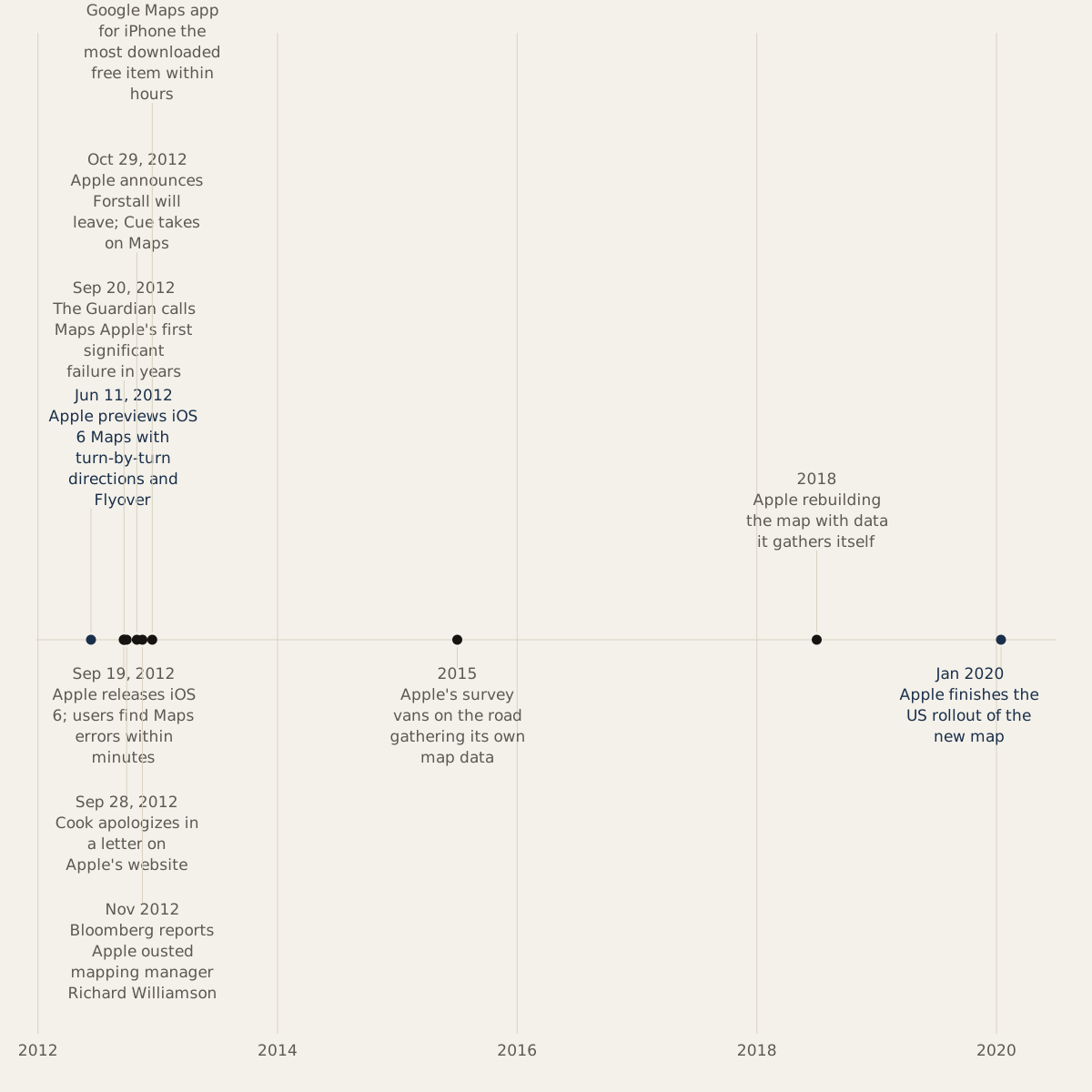
The timeline as text
- June 11, 2012Apple previews iOS 6 Maps with turn-by-turn directions and Flyover
- September 19, 2012Apple releases iOS 6; users find Maps errors within minutes
- September 20, 2012The Guardian calls Maps Apple's first significant failure in years
- September 28, 2012Cook apologizes in a letter on Apple's website
- October 29, 2012Apple announces Forstall will leave; Cue takes on Maps
- November 2012Bloomberg reports Apple ousted mapping manager Richard Williamson
- December 2012Google Maps app for iPhone the most downloaded free item within hours
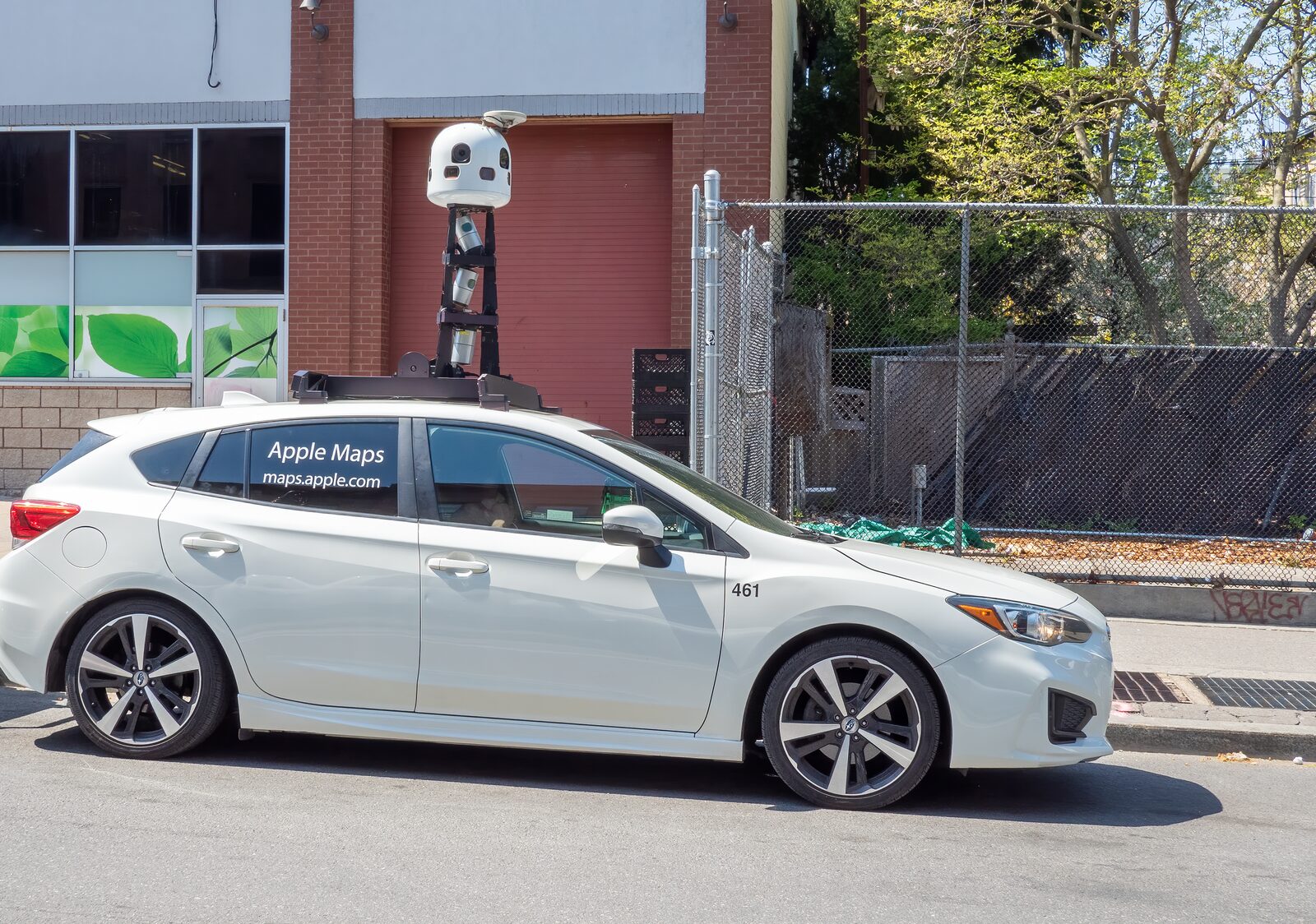
- 2015Apple's survey vans on the road gathering its own map data
- 2018Apple rebuilding the map with data it gathers itself
- January 2020Apple finishes the US rollout of the new map
- Company
- Apple
- Category
- Apps and online services
- Launched
- September 2012
- Ended
- No end date
- Stage reached
- Introduction
- AI product
- No
- Status
- Still live as of October 2026; Apple rebuilt the map and finished the US rollout in January 2020
In September 2012, Apple replaced Google Maps in iOS 6 with a map service of its own, and nine days later Tim Cook apologized for it. Maps survived, but the launch made my list of failed products.
What it was
Apple Maps was Apple's own map service, built into iOS 6 to replace Google Maps, which Computerworld called "a cornerstone of the operating system since 2007". Trudy Muller, an Apple spokeswoman, called it "our first map service" in a statement quoted by The Loop.
Apple previewed it on June 11, 2012, with spoken turn-by-turn directions and a Flyover view it said had "photo-realistic interactive 3D views". iOS 6 was a free update.
Scott Forstall, Apple's senior vice president of iOS Software, was in charge of it.
Cook later wrote in his apology letter that Apple "had to create a new version of Maps from the ground up" to add features such as turn-by-turn directions and Flyover. The Guardian reported that Apple and Google also "could not agree on licensing terms" for Google's turn-by-turn directions.
What happened
Apple released iOS 6 on September 19, 2012, and The Guardian reported that users were finding errors in the new Maps within minutes.
Cook apologized in a letter on Apple's website on September 28.
On October 29, Apple announced that Forstall would leave the company the following year and that Eddy Cue would take on Maps.
In December, Google released its own Google Maps app for the iPhone. The Guardian reported it became the most downloaded free item in the App Store within hours.
Apple kept Maps, rebuilt it and finished the US rollout of the new map in January 2020.
Why it failed
Apple's executives have since said Maps wasn't ready at launch and had never been tried by a large number of users.
What Apple said
The day after launch, Muller said Apple was "just getting started" and that "the more people use it, the better it will get," as quoted by The Loop.
Cook's letter said Apple "fell short" and was "extremely sorry for the frustration this has caused" its customers. While Maps improved, he suggested the Bing, MapQuest and Waze apps, or Google's and Nokia's map websites. The letter gave no cause beyond falling short, and it didn't mention data providers, testing or any executive.
Apple's October release described the executive changes as a way to "encourage even more collaboration" and didn't link them to the Maps launch.
In 2016, Cue and Craig Federighi talked to Fast Company on the record. "We completely underestimated the complexity of the product," Cue said. Federighi called Maps "a huge data integration and data-quality issue", with data coming "from a lot of providers".
Cue also said, "We were never able to take it out to a large number of users to get that feedback." He added that "to all of us living in Cupertino, Maps seemed pretty darn good." Fast Company's longer feature quotes him saying the reason customers can test iOS "is because of Maps."
In April 2026, Cook called the Maps launch his "first really big mistake" as CEO and told a town hall meeting, "The product wasn't ready," Bloomberg reported.
What reporting showed
On September 20, The Guardian wrote that Apple was facing "its first significant failure in years" over Maps. Users had reported London moved to Ontario, Paddington station missing, the Sears Tower in Chicago shrunk and Helsinki's railway station turned into a park. Ireland's justice minister, Alan Shatter, said Maps marking a farm as an airport was "dangerously misleading".
GeekWire reported that Flyover showed the Tacoma Narrows Bridge with half the structure looking collapsed, and Washington State's transport department tweeted that the bridges "have not melted".
AppleInsider was kinder. It called the Flyover errors "not serious bugs", but said the app lacked Google's Street View and transit directions. The Guardian counted "the loss of public transport directions compared with the Google data" among the complaints.
In December, The Guardian reported that police in Mildura, Australia, had warned drivers about Maps. Senior Sergeant Stephen Phelan said the app put the town "at least 70 kilometres" from where it should be, and the police called it "potentially a life-threatening issue" because of the heat and lack of water. Apple updated the location on December 10, the paper said.
Reporters tied the executive exits to Maps. The Verge, citing sources, reported that Forstall thought the complaints about data quality were overblown and refused to sign the apology letter, and called that his "fatal mistake". In November, The Guardian, citing Bloomberg, reported that Apple had ousted Richard Williamson, the manager of its mapping division, without a public announcement.
What later analysis found
Fast Company wrote in 2016 that Forstall, who was "eased out" soon after the launch, had overseen "dozens of people working in relative isolation" on Maps. The magazine said several thousand people worked on it by then.
TechCrunch wrote that Maps worked for Apple employees because its data was "pretty accurate for Cupertino", but "outside of this bubble, Maps wasn't great."
Two years later, TechCrunch said the original app relied on "a patchwork of data from partners like TomTom, OpenStreetMap and other geo data brokers", and called its reliance on third-party data "one of its major pitfalls from the beginning". The site said Apple was by then rebuilding the map with data it gathered itself, including from survey vans on the road since 2015.
The stage it reached
The Apple Maps launch was an introduction stage failure, an established company launching into a market that Google Maps already held on Apple's own phone.
It wasn't a typical introduction. Maps came preloaded with iOS 6, and Cook's letter said more than 100 million iOS devices were already using it, far beyond early adopters. Cue told Fast Company in 2016 that it "doesn't have a direct revenue stream," so the sales tests in my product life cycle posts don't fit it either.
ComScore counted 35 million US iPhone owners using Apple's maps in September 2013, The Guardian reported. Flyover's 3D view is still offered too, and Apple shipped what its September 2026 announcement called an "enhanced Flyover experience".
The closest parallel I know is Samsung's first Galaxy Fold, a first version that failed in public while the product line carried on.
The lesson
I think the lesson from the Apple Maps launch is that your own staff are a poor test for a product whose quality depends on places they don't go.
Dogfooding is usually the first step in a product feedback loop, and it's a good one.
A map has to work everywhere on day one, and so does any product that ships as the default to your whole customer base. Get it to outside users before launch, in the places you know least, and decide what "ready" means before the date is set.
I'd copy the apology, though. Telling customers to use a competitor's app until yours is fixed is a hard call, and I think it was the right one.
Causes at a glance
Company statement · Rushed launch
Apple says it wasn't ready and was never put in front of many users before launch
Reporting at the time · Accuracy
Places were missing or misplaced, and Flyover showed bridges that looked melted
Later analysis · Quality and reliability
Built on a patchwork of partners' map data, which TechCrunch called a major pitfall
Source 19
Reporting at the time · Competition
It replaced Google Maps, part of iOS since 2007, and lacked its transit directions
Sources
- 1.Apple, Apple Previews iOS 6 With All New Maps, Siri Features, Facebook Integration, Shared Photo Streams & New Passbook App
June 2012 · Company statement
- 2.Apple, Apple Introduces iPhone 5
September 2012 · Company statement
- 3.The Loop, Apple responds to Maps criticism
September 2012 · Reporting at the time
- 4.The Guardian, Apple Maps service loses train stations, shrinks tower and creates new airport
September 2012 · Reporting at the time
- 5.GeekWire, Apple's iOS 6 maps melt the Tacoma Narrows Bridge
September 2012 · Reporting at the time
- 6.AppleInsider, Inside iOS 6: What's wrong with Apple's new Maps
September 2012 · Reporting at the time
- 7.Apple, A letter from Tim Cook on Maps
September 2012 · Company statement
- 8.Computerworld, Experts applaud Apple CEO Tim Cook's apology over Maps misstep
September 2012 · Reporting at the time
- 9.The Guardian, Apple Maps: Tim Cook says he is 'extremely sorry'
September 2012 · Reporting at the time
- 10.Apple, Apple Announces Changes to Increase Collaboration Across Hardware, Software & Services
October 2012 · Company statement
- 11.The Verge, Apple's Scott Forstall's fatal mistake was not signing iOS 6 Maps apology letter: sources
October 2012 · Reporting at the time
- 12.The Guardian, Apple fires head of mapping team after backlash from customers
November 2012 · Reporting at the time
- 13.The Guardian, Apple redraws maps after Australian drivers led astray in the bush
December 2012 · Reporting at the time
- 14.The Guardian, Google Maps iPhone app goes straight to the top of Apple's most-downloaded
December 2012 · Reporting at the time
- 15.The Guardian, Apple maps: how Google lost when everyone thought it had won
November 2013 · Reporting at the time
- 16.Fast Company, Playing The Long Game Inside Tim Cook's Apple
August 2016 · Later analysis
- 17.TechCrunch, The Apple Maps launch fiasco led to the iOS public beta program
August 2016 · Later analysis
- 18.Fast Company, Eddy Cue And Craig Federighi Open Up About Learning From Apple's Failures
August 2016 · Later analysis
- 19.TechCrunch, Apple is rebuilding Maps from the ground up
June 2018 · Later analysis
- 20.Apple, Apple delivers a new redesigned Maps for all users in the United States
January 2020 · Company statement
- 21.Bloomberg, Tim Cook Regrets Maps Flub, Sees Apple Watch as Proudest Work
April 2026 · Later analysis
- 22.Apple, Major updates for Apple's software platforms are now available
September 2026 · Company statement
More from the graveyard
Mar 2023
Google Glass
Google · Wearables
Google stopped selling Glass Enterprise Edition on March 15, 2023
Mar 2016
Tay
Microsoft · Assistants and chatbots · AI
Taken offline after about 16 hours; a brief return ended on March 30, 2016
Aug 2015
Amazon Fire Phone
Amazon · Phones
Amazon ceased sales in August 2015, when the phone sold out