Consumer hardware NOV 12, 2026 6 MIN READ
Amazon Dash Button
My post on failed products examples covers twelve famous cases from tech and why each one failed.



The timeline as text
- March 31, 2015Announced, with invitations to select Prime members
- September 2015Open to any Prime member, from 29 brands
- March 31, 2016Over 100 buttons; Amazon said orders came more than once a minute
- August 2016Launched in the UK, Germany and Austria
- April 2017Amazon said orders came more than four times a minute
- January 10, 2019A Munich court ruled the buttons broke German consumer law
- February 28, 2019Amazon stopped selling Dash Buttons worldwide
- August 31, 2019The buttons stopped placing orders, as Amazon had announced
- Company
- Amazon
- Category
- Consumer hardware
- Launched
- March 2015
- Ended
- August 2019
- Stage reached
- Growth
- AI product
- No
- Status
- Amazon said Dash Buttons would stop placing orders worldwide on August 31, 2019
Amazon said it ended the Dash Button because shoppers were turning to other ways to reorder, such as Alexa voice shopping, though a German court had already ruled that the buttons broke consumer law by not showing the price. Sales ended in February 2019, and the buttons stopped placing orders that August.
What it was
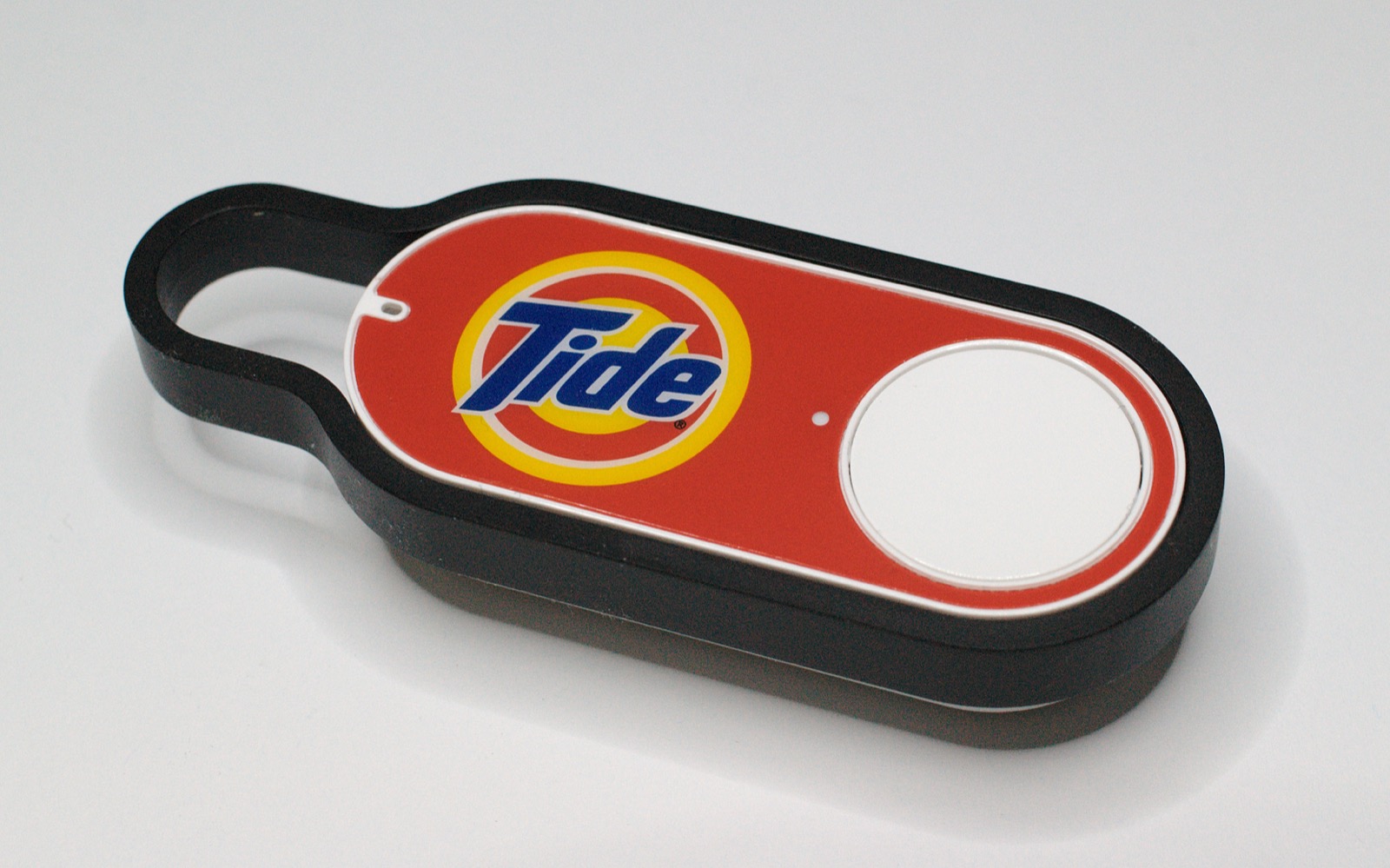
The Dash Button was a small Wi-Fi button that reordered one household product from Amazon with a single press.
Each button carried one brand's logo, and its owner picked the exact item in a phone app. Engadget described it at launch as a way to reorder "items like toilet paper, diapers and laundry detergent as soon as they run out."
Prime members could buy them at $4.99 each, credited back on the first order, Amazon's March 2016 announcement said.
Amazon said in October 2015 that the buttons ran on Dash Replenishment, the same service that let a connected device reorder its own supplies, like "a water pitcher that orders filters."
Daniel Rausch, an Amazon vice president who helped grow the program, told CNET the aim was "to make shopping disappear" for things like paper towels and printer ink.
What happened
Amazon announced the Dash Button on March 31, 2015, with email invitations to select Prime members, limited to three buttons per household, Engadget reported. The public's first reaction, Fortune wrote later, was that Amazon "was playing a massive prank" timed for April Fool's Day.
Amazon's first-quarter results that April listed 18 brands, among them Bounty, Huggies and Clorox. By September 2015, any Prime member could order a button, from 29 brands, NBC News reported.
On March 31, 2016, Amazon said it offered more than 100 buttons and that customers used them "more than once a minute." By June it said orders came "over twice a minute."
The program reached the UK, Germany and Austria in August 2016, Amazon said.
In April 2017, Fortune reported that Dash orders came more than four times a minute, against once a minute a year earlier, according to Amazon.
On January 10, 2019, the Higher Regional Court of Munich ruled that the buttons broke German consumer law, in a case brought by the consumer protection body for North Rhine-Westphalia, Der Spiegel reported. Amazon said it would fight the ruling.
On February 28, 2019, Amazon stopped selling Dash Buttons worldwide. Its statement said existing buttons would keep working.
Five months later, Amazon said that from August 31, 2019, customers "will no longer be able to place orders through Dash Button devices globally," GeekWire reported. It had already created virtual Dash Buttons on its website and app to replace the physical ones.
Stiftung Warentest later confirmed the switch-off. By November 2020 it reported that Germany's Federal Court of Justice had rejected Amazon's complaint that the Munich court refused to allow an appeal, making the ruling final.
Why it failed
By Amazon's account, the Dash Button ended because shoppers had turned to other ways to reorder, and every one it named was an Amazon program. Reporting added a German ruling over prices and figures showing how small Dash stayed next to the rest of Amazon.
What Amazon said
Amazon's statement on ending sales said it had "seen customers increasingly using programs like Alexa Shopping" and Subscribe & Save, and that Dash Replenishment had put automatic reordering into "hundreds of devices globally." With that in mind, it was shifting "the Dash program focus."
"Dash button was an awesome stepping stone into the world of connected home," Rausch told CNET, later adding, "We never imagined a future where customers had 500 buttons in their home." He said the button's "core mission" had succeeded.
In August, Amazon pointed again to "continued growth of other shopping options," and a spokeswoman told CNET that usage "has significantly slowed" since sales stopped.
When the Munich court ruled, an Amazon spokesman called the decision "hostile to innovation," Reuters reported. Neither of Amazon's later statements mentions the ruling, and The Verge noted that Amazon "offered no indication" that ending sales was related to it.
What reporting showed
The German court ruled that the buttons "do not give sufficient information about the product ordered or its price," Reuters reported. Amazon's terms also let it change the price or send a comparable product, and the court found that unlawful too, according to Stiftung Warentest.
Fortune's Leena Rao wrote in 2017 that Dash was among Amazon's fastest growing services, "albeit from a very small baseline." Her back-of-the-napkin math put four orders a minute at about 5,760 a day, which she called insignificant next to Amazon overall.
Retail data firm Slice Intelligence counted a 650% increase in Dash orders in July 2016 from a year earlier, Fortune reported.
Amazon hadn't disclosed how many customers used the buttons or what revenue they brought in, Der Spiegel noted in January 2019.
In launch week, Glenn Fleishman doubted the one-brand design in a PCWorld column, asking how many Amazon shoppers were "such brand lovers that they want a button in their house."
Der Spiegel also reported that the Institute for Retail Research in Cologne saw order buttons as a stopgap that voice control and smart home devices would replace. That was seven weeks before Amazon gave much the same reason.
The stage it reached
The Dash Button reached the growth stage of the product life cycle, where sales rise fast on new customers and the rate matters more than the total.
On Amazon's figures, the order rate more than quadrupled in the year to April 2017, and Slice Intelligence's count points the same way. The total stayed small, as Fortune's math showed.
Amazon's own reason sounds like the decline stage, when customers move to a substitute, often from the same company. I don't count it as one. The only fall in usage I found reported came after Amazon stopped selling the buttons, so growth is the furthest stage the evidence shows.
The lesson
I think the Dash Button did the job Amazon built it for, and the job was always going to move somewhere else.
Rausch said Amazon imagined "a future where the home was taking care of itself." CNET described the button as a "speedy jury-rig" for appliances that weren't online yet. Once appliances could reorder for themselves and Alexa could take an order by voice, a plastic button for each product had little left to do.
Rausch called Dash a stepping stone when Amazon stopped selling it. In October 2016, he had called its growth "exponential."
The part I'd study is the price. One press placed an order without showing what it cost, and a German court ruled that broke the law.
If you're taking friction out of buying, check which steps the customer and the law still need before you remove them. And if your product is a stopgap until something better ships, plan how you'll retire it while it's still growing.
Causes at a glance
Company statementChange of company strategy
Amazon said shoppers were using Alexa Shopping, auto-reordering and virtual buttons
Reporting at the timeRegulation
A Munich court ruled the buttons broke German consumer law by not showing the price
Reporting at the timeWeak demand
Fortune put 2017 orders at about 5,760 a day, insignificant next to Amazon overall
Reporting at the timeUnclear value
A PCWorld column doubted many shoppers wanted a single-brand button in their homes
Source3
Sources
- 1.Amazon, Amazon.com Announces First Quarter Sales up 15% to $22.72 Billion
April 2015 · Company statement
- 2.Engadget, Re-order everyday items from Amazon with the 'Dash Button'
March 2015 · Reporting at the time
- 3.PCWorld, Don't dash to Dash: new Amazon buttons aid brands, not consumers
April 2015 · Reporting at the time
- 4.Amazon, Amazon Dash Replenishment Service Adds New Device Brands
October 2015 · Company statement
- 5.NBC News, Amazon Makes Dash Buttons Free, After One Use
September 2015 · Reporting at the time
- 6.Amazon, More Than 100 Amazon Dash Buttons Now Available, Giving Prime Members the Easiest Way to Order Thousands of Products
March 2016 · Company statement
- 7.Amazon, Amazon Dash Button Continues Rapid Growth: Orders Increase; Brands, Categories and Selection Expand
June 2016 · Company statement
- 8.Amazon, Amazon Dash Button Continues Exponential Growth
October 2016 · Company statement
- 9.Fortune, Two Years After Launching, Amazon Dash Shows Promise
April 2017 · Reporting at the time
- 10.Reuters, Court says Amazon 'Dash' buttons violate German law
January 2019 · Reporting at the time
- 11.Der Spiegel, Oberlandesgericht München verbietet Amazons Dash Buttons
January 2019 · Reporting at the time
- 12.Amazon (statement printed by GeekWire), Amazon ending sales of physical Dash Buttons, one of its wackiest smart home innovations
February 2019 · Company statement
- 13.CNET, Amazon stops selling Dash buttons, goofy forerunners of the connected home
February 2019 · Reporting at the time
- 14.The Verge, Amazon's press-to-order Dash buttons are officially discontinued
February 2019 · Reporting at the time
- 15.BBC News, Amazon stops selling Dash buttons
March 2019 · Reporting at the time
- 16.Amazon (statement printed by GeekWire), Goodbye, Dash: Amazon will end support for geeky shopping gadgets
August 2019 · Company statement
- 17.CNET, Amazon is going to kill your Dash button
August 2019 · Reporting at the time
- 18.Stiftung Warentest, Dash-Buttons: Amazon schaltet Bestellknöpfe ab
November 2020 · Reporting at the time