TV and video NOV 9, 2026 6 MIN READ
HD DVD
My post on failed products examples covers twelve famous cases from tech and why each one failed.



The timeline as text
- March 31, 2006The first HD DVD player goes on sale in Japan, ahead of Blu-ray
- April 18, 2006The first HD DVD players and films reach US stores
- August 20, 2007Paramount and DreamWorks Animation back HD DVD only
- January 4, 2008Warner Bros. says it will release high-def titles only on Blu-ray
- January 2008Toshiba cuts its US player prices by 40 to 50 percent
- February 11, 2008Netflix says it will buy only Blu-ray high-def discs
- February 15, 2008Wal-Mart says it will stop selling HD DVD in June
- February 19, 2008Toshiba says it will stop making and marketing HD DVD players
- March 28, 2008The HD DVD Promotion Group dissolves
- Company
- Toshiba
- Category
- TV and video
- Launched
- March 2006
- Ended
- February 2008
- Stage reached
- Introduction
- AI product
- No
- Status
- Toshiba said on February 19, 2008, that it would no longer develop, make or market HD DVD players and recorders
HD DVD lost its format war with Sony's Blu-ray. Toshiba gave it up in February 2008, after Warner Bros., Wal-Mart, Best Buy and Netflix had picked Blu-ray and Sony had built a Blu-ray player into every PlayStation 3.
What it was
HD DVD was Toshiba's disc format for high-definition movies, one of two incompatible formats meant to replace the DVD.
Toshiba's 2008 release said HD DVD was developed "to offer consumers access at an affordable price to high-quality, high definition content."
At launch, NEC, Universal Studios, Warner Bros., Intel and Microsoft backed it, AP reported. Sony and Matsushita, the maker of Panasonic products, backed Blu-ray.
What happened
HD DVD reached stores before Blu-ray and was dropped less than two years later.
Toshiba started selling the first HD DVD player in Japan on March 31, 2006, beating Blu-ray to market, AP reported. The first US players, at $499 and $799, went on sale with the first films on April 18, 2006, bit-tech reported.
Blu-ray pulled ahead on discs. From January 1 to August 12, 2007, buyers took home 2.1 million Blu-ray discs and 1.1 million HD DVDs, Home Media Research told the Los Angeles Times. Target was stocking only Blu-ray players, and Blockbuster had said it would carry Blu-ray only, The New York Times reported.
On August 20, 2007, Paramount and DreamWorks Animation said they would release high-definition movies only on HD DVD. "HD DVD is simply less expensive," said Paramount's Rob Moore.
Two unnamed Viacom executives told the Times the two studios would get about $150 million in incentives, in cash and promotional guarantees.
On January 4, 2008, Warner Bros. said it would release its high-definition titles only on Blu-ray, with new HD DVD releases ending after May 2008. "Consumers have clearly chosen Blu-ray," said Kevin Tsujihara, president of its home entertainment group.
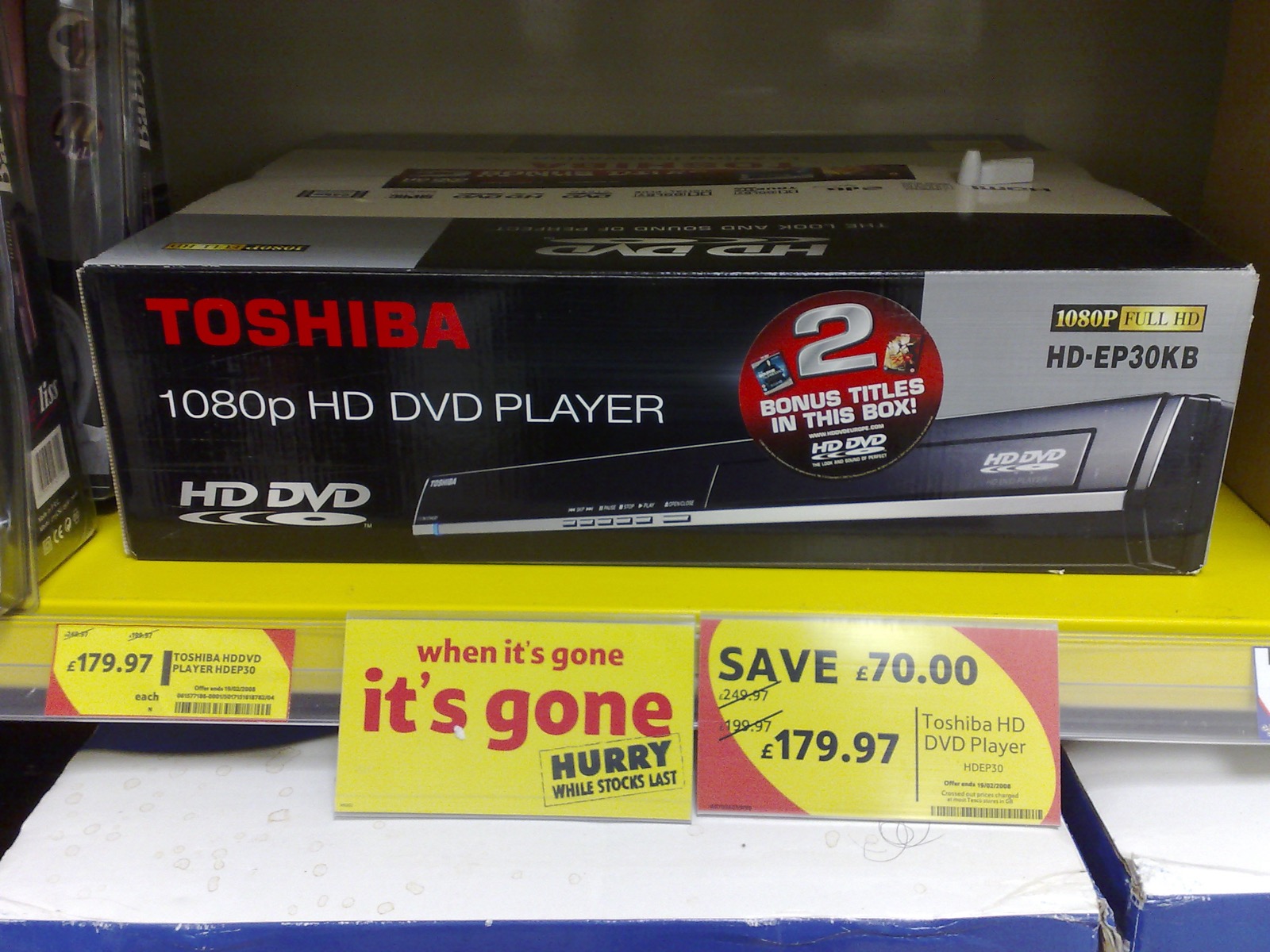
In mid-January, Toshiba cut its US player prices by 40 to 50 percent, to between $149 and $399, Reuters reported.
Retailers and Netflix moved in February. Netflix said on February 11 that it would buy only Blu-ray discs and phase out HD DVD by roughly the end of the year. Best Buy said that week it would promote Blu-ray as its preferred format.
On February 15, Wal-Mart, the largest DVD retailer in the US, said it would stop selling HD DVD discs and players in June, The New York Times reported.
Four days later, Toshiba announced that it would "no longer develop, manufacture and market HD DVD players and recorders," aiming to end those businesses by the end of March 2008.
The HD DVD Promotion Group dissolved on March 28, Engadget reported.
Why it failed
Toshiba cited recent major changes in the market and said Warner's switch surprised it. Reporting at the time pointed to Sony's PlayStation 3 and to a split market that kept buyers waiting.
What Toshiba said
Toshiba's release said the decision followed "recent major changes in the market." Its president and CEO, Atsutoshi Nishida, said the company had assessed "the long-term impact of continuing the so-called 'next-generation format war'" and concluded that "a swift decision will best help the market develop."
Asked at the Tokyo press conference what caused the failure, Toshiba answered that it was "clearly in a good place until last December and January" and "very, very surprised by Warner's announcement," according to Engadget's live blog.
When Warner moved in January, Toshiba said it was "particularly disappointed," adding that HD DVD players and PCs "have outsold Blu-ray in the US market in 2007," The Register reported.
Neither the release nor those comments named the PlayStation 3.
What reporting showed
The BBC's Will Smale wrote that "Sony had the killer edge" because the PlayStation 3 came "pre-fitted with a Blu-ray player," with 10.5 million sold since late 2006. Xbox 360 owners needed an external drive to play HD DVDs, and Toshiba's one million sales figure included those drives. "When Warner made its decision, it was basically over," Kazuharu Miura, an analyst at Daiwa Institute of Research, said in the same piece.
In January a Toshiba marketing executive cited NPD figures putting HD DVD at 49.3 percent of high-definition players sold as of December 22. Those figures left out the PlayStation 3, AP noted, and Blu-ray had "consistently beaten HD DVD in the number of discs sold."
The split itself had been "widely blamed for the slow adoption of high-definition players," AP added. Andy Parsons of the rival Blu-ray Disc Association told the Times in February that many consumers had sat on the sidelines.
Gartner doubted that cheaper players would save the format. Its analyst Hiroyuki Shimizu wrote that the price cuts "may prolong HD DVD's life a little, but the limited line-up of film titles will inflict fatal damage on the format," PC World reported.
What later analysis found
In a 2009 discussion paper at the University of Hohenheim, Julian P. Christ and André P. Slowak found "no technological supremacy" for either format from a consumer's point of view. Film studios decided the war, they argued, "because the availability of movie releases, but not technological supremacy, made the standard attractive to consumers."
A 2008 Yale School of Management case by Jaan Elias and Sharon Oster says that after Toshiba's price cuts and a $2.7 million Super Bowl ad, "little improved." The case's figures for the week of January 26 still put Blu-ray players ahead in sales, 65 percent to 28 percent, with combo players making up the rest.
Engadget's Richard Lawler wrote in 2014 that Sony's decision to make HD discs standard on the PS3, not an add-on, "led to a hardware gap HD DVD could never surmount."
The stage it reached
HD DVD died in the introduction stage, which the product life cycle guide describes as the launch period, when awareness is low and sales are small.
Its sales stayed small next to the DVD's. Home Media Research counted nearly half a billion standard DVDs sold from January 1 to August 12, 2007.
Prices moved fast, another mark of the stage. The cheaper US player cost $499 at launch in 2006. By August 2007 some HD DVD players sold for $299, DreamWorks Animation's Jeffrey Katzenberg said, and in January 2008 Toshiba's range started at $149.
It never reached growth, so I count it as a failure, not a decline. Like 3D TV, it was a living-room format that needed other companies to make things for it.
The lesson
I think HD DVD lost in places Toshiba didn't control, on studio release slates, retail shelves and a rival's game console.
It was first to market, and its players were about $200 cheaper than Blu-ray machines in August 2007, the Times reported. Neither mattered once the movies and the installed base went the other way.
If your product only works when other companies back it, their commitments are your real adoption numbers. Track them as closely as your own sales, and decide in advance which partner leaving would make you stop.
Toshiba did get the ending right. It quit 46 days after Warner's announcement, rather than cutting prices further in a war it had already lost.
Causes at a glance
Company statementMissing apps, content or partners
Toshiba cited major market changes and said Warner's move to Blu-ray surprised it
Reporting at the timeCompetition
The PlayStation 3 came with a Blu-ray player built in, which the BBC called Sony's edge
Reporting at the timeWeak demand
Two incompatible formats left many buyers waiting on the sidelines for a winner
Later analysisMissing apps, content or partners
A 2009 paper found the studios' movie releases, not technology, decided the war
Sources
- 1.Toshiba, Toshiba Announces Discontinuation of HD DVD Businesses
February 2008 · Company statement
- 2.NBC News (Associated Press), High-def DVD beats Blu-ray to market
March 2006 · Reporting at the time
- 3.bit-tech, HD-DVD - it's here!
April 2006 · Reporting at the time
- 4.The New York Times, Two Studios to Support HD DVD Over Rival
August 2007 · Reporting at the time
- 5.Los Angeles Times (The Honolulu Advertiser), Paramount, DreamWorks throw a curve ball, pick HD DVD format
August 2007 · Reporting at the time
- 6.Warner Bros. Entertainment (Time Warner), Warner Bros. Entertainment to Release Its High-Definition DVD Titles Exclusively in the Blu-Ray Disc Format Beginning Later This Year
January 2008 · Company statement
- 7.The Register, Warner Bros gives all its hi-def loving to Blu-ray
January 2008 · Reporting at the time
- 8.Associated Press, Toshiba Defiant After HD DVD Setback
January 2008 · Reporting at the time
- 9.Reuters, Toshiba cuts HD player prices in Blu-ray fight
January 2008 · Reporting at the time
- 10.PC World (IDG News Service), Gartner: HD DVD Price Cuts Only Prolong Agony
January 2008 · Reporting at the time
- 11.Netflix, Netflix, Citing a Clear Signal From the Industry, Will Carry High-Def DVDs Only in Blu-ray Format
February 2008 · Company statement
- 12.The New York Times, Taps for HD DVD as Wal-Mart Backs Blu-ray
February 2008 · Reporting at the time
- 13.BBC News, How the PS3 led Blu-ray's triumph
February 2008 · Reporting at the time
- 14.Engadget, Live from Toshiba's HD DVD press conference in Tokyo
February 2008 · Reporting at the time
- 15.Engadget, HD DVD Promotion Group officially dissolves in a high-res burst of tears
March 2008 · Reporting at the time
- 16.Yale School of Management (Jaan Elias and Sharon Oster), Sony-Toshiba B
November 2008 · Later analysis
- 17.University of Hohenheim, FZID Discussion Papers (Julian P. Christ and André P. Slowak), Why blu-ray vs. HD-DVD is not VHS vs. Betamax: the co-evolution of standard-setting consortia
July 2009 · Later analysis
- 18.Engadget, Format Wars: Blu-ray vs. HD DVD
June 2014 · Later analysis