Consumer hardware NOV 8, 2026 6 MIN READ
Juicero
My post on failed products examples covers twelve famous cases from tech and why each one failed.



The timeline as text
- March 31, 2016Unveiled the Press at $699, selling first in California
- January 17, 2017Cut the Press price from $699 to $399
- April 19, 2017Bloomberg reported the packs could be squeezed by hand
- April 20, 2017CEO Jeff Dunn offered refunds on the Press for 30 days
- July 14, 2017Fortune reported plans for faster price cuts and layoffs
- September 1, 2017Suspended sales of the Press and Produce Packs
- December 1, 2017Last day to ask for a refund on the Press
- Company
- Juicero
- Category
- Consumer hardware
- Launched
- March 2016
- Ended
- September 2017
- Stage reached
- Introduction
- AI product
- No
- Status
- Juicero suspended sales of the Press and its Produce Packs on September 1, 2017
Juicero failed because its press and juice packs cost too much for the scale it wanted, by its CEO's own account, and Bloomberg showed the packs could be squeezed by hand almost as well as by the machine. It suspended sales of both on September 1, 2017.
What it was
Juicero was a Wi-Fi-connected countertop press that squeezed juice out of packs of chopped organic produce, which the company sold and delivered.
Each pack made one 8-ounce glass and carried a QR code the Press read to check freshness and order a replacement, Fortune reported at launch.
Doug Evans, a former CEO of the juice chain Organic Avenue, founded Juicero in 2013. He told Fortune that creating "8,000 lbs of force in a countertop unit" took special metals and gears, and that he'd raised somewhere around $120 million.
What happened
Juicero unveiled the Press on March 31, 2016, at $699, with packs at $4 to $10 each, according to its launch release. It sold first in California, with presses due to ship that summer.
In late 2016, Jeff Dunn, a former president of Coca-Cola North America, replaced Evans as CEO, TechCrunch reported. A company spokesperson said Evans stayed on as chairman.
On January 17, 2017, Juicero cut the Press to $399, 12 to 18 months ahead of plan, Fortune reported.
Bloomberg reported on April 19, 2017, that the packs could be squeezed by hand. In its test, as Snopes quoted it, reporters got 7.5 ounces of juice by hand in a minute and a half, and the machine got 8 ounces in about two minutes.
The next day, Dunn wrote on Medium that hand-squeezing was "a mediocre (and maybe very messy) experience" and offered any customer a refund on the Press for 30 days.
Fortune reported on July 14, 2017, that Dunn had told employees in a letter that Juicero would lower prices faster and lay off about a quarter of its staff. Evans was stepping back from daily operations, the letter said.
On September 1, 2017, Juicero told customers that, "after selling over a million Produce Packs," it was suspending sales of the Press and the packs immediately. It offered Press refunds until December 1, 2017, and said it would look for an acquirer "with an existing national fresh food supply chain."
Why it failed
Juicero said it couldn't bring its prices down on its own. Reporting pointed to the hand-squeezing story and slow sales, and a teardown by Bolt's Ben Einstein blamed costly engineering done before any proof of demand.
What Juicero said
In January 2017, Dunn said costs were falling. He told Fortune that a Black Friday price under $400 had doubled the number of users in one day, and that the cost per unit was coming down "faster than we thought."
By mid-July, he'd written to staff that a $399 Press and packs at $5 to $7 were "not a realistic way for us to fulfill our mission at the scale to which we aspire," Fortune reported.
The shutdown notice said Juicero had looked for ways to source, make and deliver for less, and found that a national manufacturing and distribution system "requires infrastructure that we cannot achieve on our own as a standalone business."
Nothing in the notice mentioned the hand-squeezing story. Dunn's letter to staff had called it frustrating to read about "something we always knew about, and that our customers simply aren't interested in doing." It also said less than 5% of customers took the refund, according to Fortune.
What reporting showed
Two investors told Bloomberg they hadn't known the packs could be squeezed by hand and felt Juicero hadn't delivered on its original pitch, Fortune reported. Investor Doug Chertok told Bloomberg there was "no doubt the packs can be squeezed without the machine," and that he was "still a huge fan."
Bloomberg's sources, as Vox quoted them, said Evans raised money in 2014 "by showing 3D-printed renderings of the product without a working prototype." A source with ties to Juicero disputed Bloomberg's report, Snopes reported, saying they'd never got "more than 6 ounces" by hand.
Vox's Timothy B. Lee wrote, "What makes the Juicero genuinely ridiculous is how over-engineered it is."
When Juicero cut the price in January, TechCrunch wrote that it was "hard not to see the price cut as an indication of how tough of a sell the device initially was."
At the end, The Guardian wrote that Juicero had become "something of a symbol of the absurd Silicon Valley startup industry that raises huge sums of money for solutions to non-problems."
Bloomberg's post-mortem, by the two reporters behind the April story and Brad Stone, called the shutdown "the culmination of unsustainable costs, slow sales and unflattering media reports."
What later analysis found
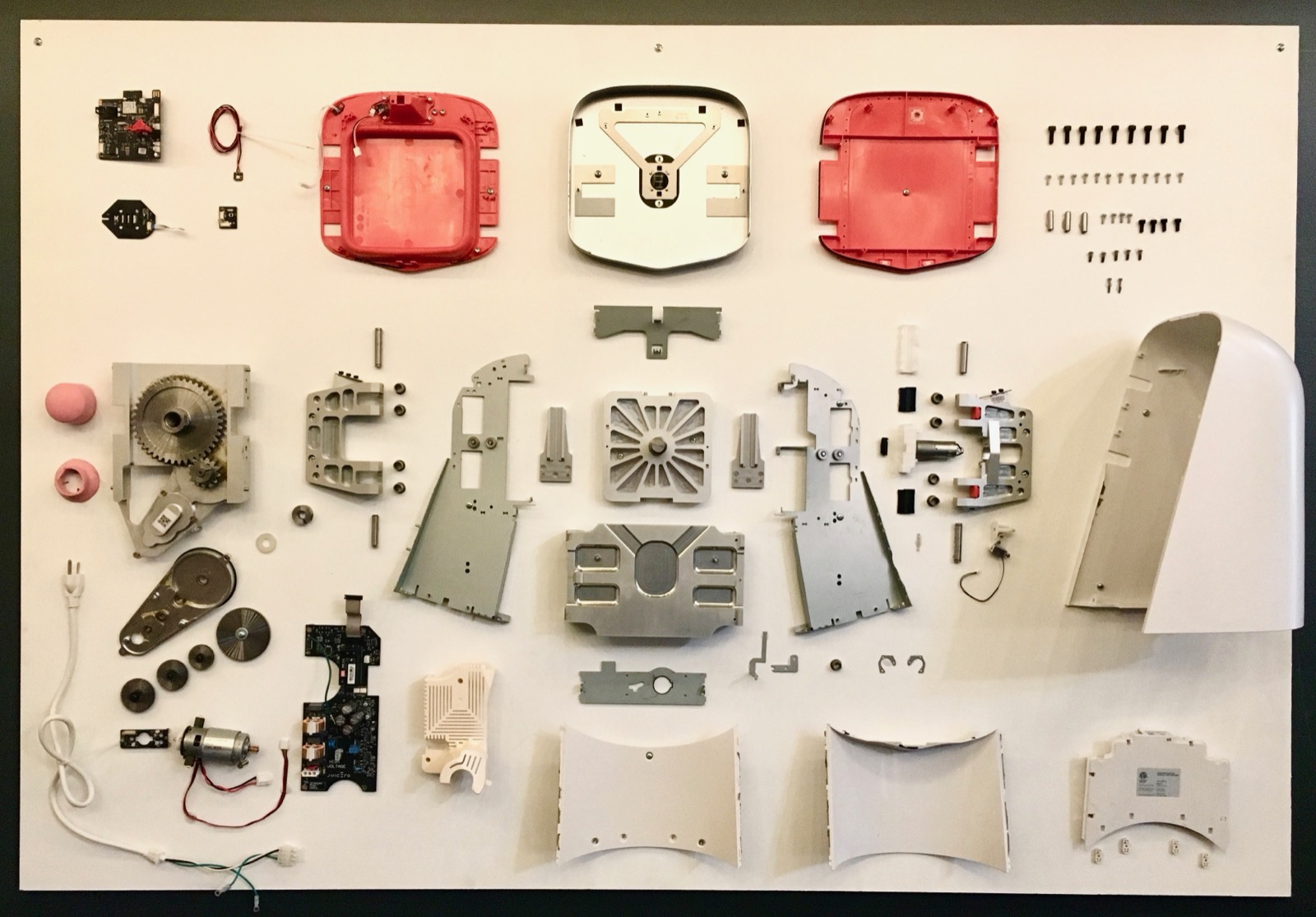
Ben Einstein, a general partner at Bolt, took a Press apart in April 2017, four months before the shutdown, and put it in the top 5% for complexity of the hundreds of consumer products he'd taken apart.
He counted eight large machined parts. Most hardware startups avoid them, he wrote, because "the cost doesn't decline much as production volumes increase." His rough guess was that they made up over 50% of the bill of materials cost.
The design pressed the whole pack at once, which took "thousands of pounds of force." A hand presses on a much smaller area, and a more focused mechanism "could easily save hundreds of dollars off the shelf price," he wrote.
His verdict was that Juicero "spent $120M over two years to build a complex supply chain and perfectly engineered product that is too expensive for their target demographic," without testing its core assumptions on real customers first.
Five years later, The Takeout reported that Juicero had been losing roughly $4 million a month, and that Dunn's response had come "too little too late."
The stage it reached
Juicero died in the introduction stage, the launch period when sales are small and costs run well ahead of revenue.
Its price moved within ten months of launch, one of the stage's signals. It sold in three states in January 2017 and 17 by April, according to TechCrunch and Snopes.
I read Dunn's Black Friday test, a price cut that doubled users in one day, as a sign the base was still small.
Like the Humane AI Pin, another $699 device, it never reached growth, so I count it as a failure, not a decline.
The lesson
I think Juicero's mistake was engineering for the hardest version of the job before checking how hard the job was.
Evans built a press for four tons of force. Bloomberg's reporters got 7.5 of its 8 ounces with their hands. I'd want that test run before anyone ordered eight machined parts.
Apply the KISS principle to the hardware as well as the screens. Ship the simplest machine that does the job, and add force when customers show you they need it.
Then price it against the free alternative, which for Juicero was a pair of hands.
Causes at a glance
Company statementPricing
Its CEO wrote that a $399 press and $5 to $7 packs weren't realistic at its target scale
Reporting at the timeUnclear value
Bloomberg showed the packs could be squeezed by hand almost as well as by the press
Reporting at the timeWeak demand
Bloomberg tied the shutdown to unsustainable costs, slow sales and bad press
Later analysisBusiness model and costs
Bolt's Ben Einstein said $120M went on a costly press and supply chain before any proof
Sources
- 1.Juicero (Business Wire), Juicero Introduces First Countertop Cold-Press Juicing System
March 2016 · Company statement
- 2.Fortune, This Man Just Raised $120 Million for a Fancy Home Juicer
April 2016 · Reporting at the time
- 3.Fortune, Juicero Slashes Connected Juicer Price from $699 to $399
January 2017 · Reporting at the time
- 4.TechCrunch, Juicero cuts the price of its luxury juicer by $300
January 2017 · Reporting at the time
- 5.TechCrunch, Juicero loses another member of its founding team
January 2017 · Reporting at the time
- 6.Fortune, This $400 Machine Just Squeezes Juice Out of a Bag
April 2017 · Reporting at the time
- 7.Snopes, $400 Juicer No Better Than Hand-Squeezing?
April 2017 · Reporting at the time
- 8.Juicero (Jeff Dunn, on Medium), A Note from Juicero's New CEO
April 2017 · Company statement
- 9.Vox, Juicero, the $399 internet-connected juicer, explained
April 2017 · Reporting at the time
- 10.The Bolt Blog (Ben Einstein), Here's Why Juicero's Press is So Expensive
April 2017 · Later analysis
- 11.TechCrunch, Juicero may be the absurd avatar of Silicon Valley hubris, but boy is it well-engineered
April 2017 · Reporting at the time
- 12.Fortune, Startup Selling $400 Juicers Plans to Lower Prices and Cut 25% of Staff
July 2017 · Reporting at the time
- 13.Juicero, Company News (September 1, 2017 notice to customers and partners)
September 2017 · Company statement
- 14.The Guardian, Squeezed out: widely mocked startup Juicero is shutting down
September 2017 · Reporting at the time
- 15.Bloomberg, Inside Juicero's Demise, From Prized Startup to Fire Sale
September 2017 · Reporting at the time
- 16.The Takeout, Remembering Juicero, The Ultimate Silicon Valley Flop
December 2022 · Later analysis
More from the graveyard
Feb 2025
Humane AI Pin
Humane Wearables AI
Sales ended February 18, 2025; Humane said the Pins would go offline February 28, 2025
Jul 2020
Segway PT
Segway Personal transport
Segway retired the PT and ended its US production on July 15, 2020
Dec 2020
Quibi
Quibi Streaming
The app stopped working on December 1, 2020; Roku bought its content distribution rights in January 2021