Deployment Phase in SDLC: Steps, Roles and an Example
NOV 17, 2026 10 MIN READ
The deployment phase in SDLC is the sixth of the seven SDLC phases. It takes the build that passed testing, puts it into production and hands it to real users, usually a few at a time.
The invoicing tool for a plumbing firm, the made-up project that runs through this series, goes live here.
What the deployment phase is for
The deployment phase gets tested software to its users without breaking what already works, and keeps a way back for when something does break.
Deploying puts new code on the production servers. Releasing is the moment users can see it.
Feature flags pull the two apart. The code goes out switched off, and you turn it on for one person, then a group, then everyone. Pete Hodgson, writing on Martin Fowler's site, calls release toggles the most common way to separate feature release from code deployment.
The name varies too. NIST's glossary puts implementation between development and operation, which is where this phase sits. Atlassian's SDLC guide, like this series, uses implementation for the phase where the coding takes place.
Inputs and deliverables of the deployment phase
The deployment phase takes the outputs of the testing phase as its inputs and hands four deliverables to maintenance.
What comes in:
-
A release candidate - The exact build that passed testing, not one rebuilt the night before.
-
The sign-off - From QA and from whoever ran user acceptance testing, with every open defect listed and accepted.
-
Finished stories - Each one met the team's definition of done before it joined the release.
-
A rollback plan - Written down and tried on staging.
What goes out is a live system, release notes, a runbook and a monitoring dashboard. The runbook tells the person on call how to check the release is healthy, how to roll it back and who to call.
Who leads the deployment phase
Ops leads the deployment phase. In a small team that's the engineer who owns the servers and the deploy pipeline, and in a bigger company it's a platform or release team.
Four other roles take part.
-
Engineers - The people who wrote the change stay close for the first hours, because they'll find a bug fastest.
-
QA - Runs smoke tests against production once the code is out.
-
Support - Reads the release notes before customers see the change.
-
The product manager - Checks every deliverable is ready in time and makes the release calls.
It's a light phase for the PM, and I'd keep it light. Your two calls are the order of release and the go or no-go.
Steps in the deployment phase
The steps in the deployment phase run from freezing the build to handing a healthy system to maintenance.
- Freeze the release candidate. Nothing new goes into the build that passed testing.
- Deploy to staging. Run smoke tests on a copy of production, and try the rollback while you're there.
- Hold the go or no-go check. Sign-off in hand, open defects accepted, someone named on call.
- Run the data changes first. Write them so the old version still works against the new database, which keeps a rollback possible.
- Deploy to production with the flag off. The code is live and nobody sees it.
- Release in stages. One user or a small group first, then everyone.
- Watch the numbers you agreed in advance. Roll back the moment one moves the wrong way.
- Hand over. Release notes go out, the runbook goes to maintenance, and the old system gets a retirement date.
Keep each release small. DORA, the software delivery research program run by Google Cloud, says smaller changes are easier to recover from if there's a failure.
Of its five delivery metrics, I'd watch two here. Change fail rate is the ratio of deployments that need immediate intervention, and failed deployment recovery time is how long it takes to recover from one.
Deployment in agile vs waterfall
In waterfall, deployment happens once, at the end, as one large cutover. Agile deploys in small pieces, every sprint or more often.
I think that batch size is the difference between agile and waterfall that matters most in this phase.
A waterfall go-live tends to be an event. Users move over together, and a rollback can mean undoing months of work.
DORA notes that change approval has traditionally gone to people outside the team, such as a change advisory board. Its research found no evidence that a more formal, external review process was associated with lower change fail rates.
The Agile Manifesto's principles ask for working software delivered frequently, from a couple of weeks to a couple of months, with a preference to the shorter timescale.
A scrum team releases at the end of each sprint, and a kanban team ships each item when it's done.
Martin Fowler separates continuous delivery, being able to deploy frequently while sometimes choosing not to, from continuous deployment, where every change goes through the pipeline into production automatically.
The invoicing tool at the deployment phase
By this phase the invoicing tool has a green test run, the defect list and the acceptance sheet the office manager signed after a week of real jobs.
Ops freezes the release candidate and deploys it to staging, where smoke tests run on a copy of production: create an invoice, send it, check the PDF and the tax line. A test rollback runs there too.
Once the smoke tests pass, the PM holds the go or no-go check, and the code goes to production with the flag off.
The office manager goes first. With the flag on for one user, she sends real invoices from it for a week.
After a week of clean invoices, the flag goes on for the whole firm. The Word template stays available for a fortnight, then it's retired.
If something breaks, nobody redeploys anything. Ops turns the flag off and the office manager goes back to the template for the afternoon.
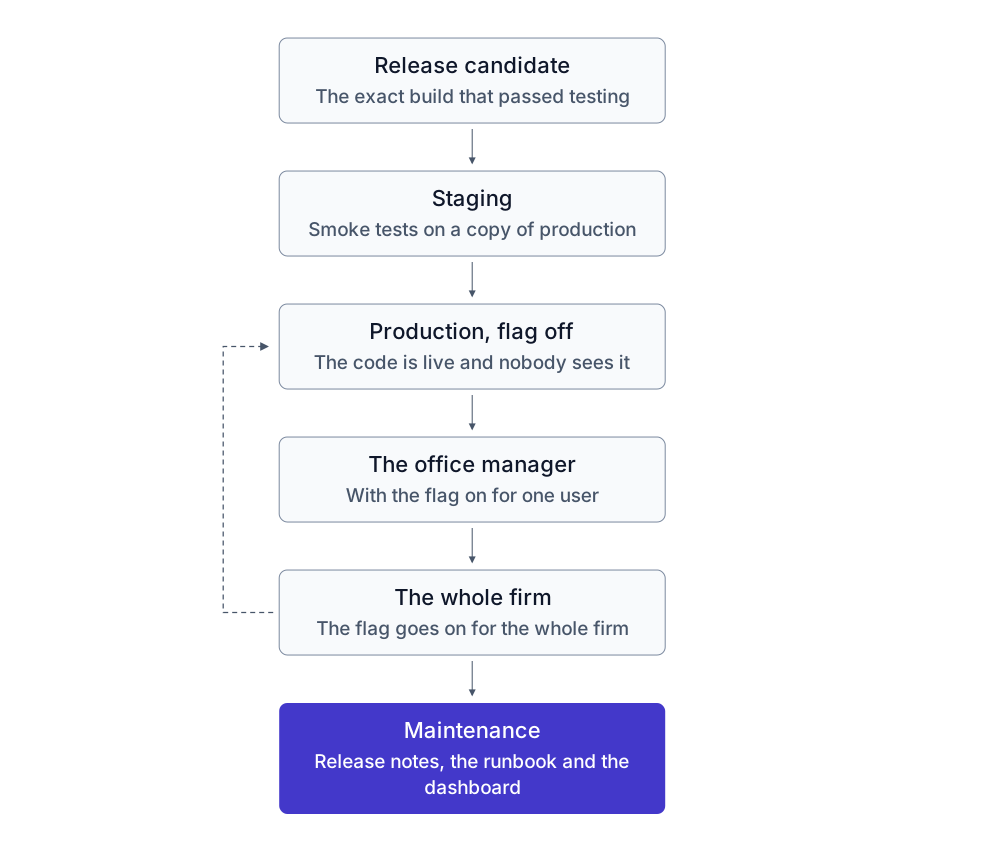
An original diagram, free to reuse with a link to this page · Download the SVG
The diagram as text
- The release candidate, the exact build that passed testing, goes to staging for smoke tests on a copy of production.
- After the go or no-go check it goes to production with the flag off: the code is live and nobody sees it.
- The office manager goes first, with the flag on for one user.
- After a week of clean invoices, the flag goes on for the whole firm.
- The Word template is retired after a fortnight, and maintenance takes over the release notes, the runbook and the dashboard.
- If something breaks, Ops turns the flag off.
One known defect ships with the release. A long customer address gets cut off on the PDF, and the release notes say so, written for the office manager rather than for engineers.
Top of the runbook is the failure she'd notice first, an invoice that never arrived, and how to resend it.
Next to the error rates, the dashboard shows the success measure from the planning brief, days from job complete to payment received. It starts counting with the office manager's first real invoice.
Common mistakes in the deployment phase
The deployment mistakes I'd guard against first are releasing to everyone at once and deploying by hand with nobody checking.
-
Everyone at once - On July 19, 2024, CrowdStrike released a content configuration update for its Windows sensor at 04:09 UTC and reverted the defect at 05:27 UTC. Microsoft estimated that the update affected 8.5 million Windows devices. Among its planned fixes, CrowdStrike's preliminary review lists a staggered deployment that starts with a canary.
-
Manual steps nobody checks - Knight Capital deployed new code in its order router in stages from July 27, 2012, and one technician didn't copy it to one of the eight servers, the SEC found. No second technician reviewed that deployment, and no written procedure required one. On August 1 that server still had the old code, and in the first 45 minutes of trading Knight's router sent more than 4 million orders while trying to fill 212 customer orders. Knight lost more than $460 million.
-
Old flags and dead code left in - In 2003 Knight stopped using a function called Power Peg but left its code on the router's production servers. The new code reused the flag that used to switch it on, so on the server the deployment missed, orders carrying that flag set off Power Peg. Pete Hodgson says release toggles should generally not stick around much longer than a week or two. Give each flag a removal date when you add it.
-
Go-live as the finish line - In why AI projects fail I point to a plan that ends with deploy and has no row for operate. I'd apply the same test to any software. Name the person who owns the release the morning after.
What AI changes in the deployment phase
AI changes the deployment phase from both ends. More change arrives at it, and some tools watch the rollout itself.
DORA's 2025 report draws on survey responses from nearly 5,000 technology professionals. It found that AI adoption, unlike the year before, had a positive relationship with software delivery throughput, but still a negative one with delivery stability. DORA's reading is that AI speeds up development, and the speed can expose weaknesses downstream.
Datadog calls Watchdog its AI engine and says it compares a new code version with previous versions to spot new types of errors or higher error rates. Harness says its AI Verify step applies machine learning to compare each deployment against a historical baseline, and its verification can trigger a rollback when it detects anomalies.
Both need history. Datadog's docs say Watchdog may not flag a faulty deployment when there weren't enough previous deployments to establish a baseline. The invoicing tool's first release has no previous version, so I'd keep a person watching that one.
If an AI reviewer sits in the gate before deployment, keep a human as the approver. GitHub's Copilot code review leaves a Comment review by default, which doesn't count toward a pull request's required approvals.
When the software has an AI feature, a prompt change is a release. LaunchDarkly says its AgentControl manages prompts, instructions and model settings outside the application code so teams can release changes without redeploying. The company's guarded rollouts cover those configs as well as flags.
I'd give a prompt change the same staged rollout as code, through one deployment pipeline for every agent.
Deployment phase checklist
Before the go or no-go call in the deployment phase, each of these should be true.
-
The release candidate is the exact build that passed testing.
-
Sign-offs are in, and every open defect is accepted by name.
-
A rollback has been tried on staging.
-
Someone is on call with the runbook, and support has the release notes.
-
Numbers that would trigger a rollback are written down.
After the release, check these.
-
Each stage holds for an agreed time before the next one starts.
-
Every new flag and the old system have a removal date.
-
Maintenance has the runbook, the dashboard and the release notes.
RELATED READING
SDLC Phases and Examples - One Project Through Every Phase
SDLC stands for software development life cycle. It's the sequence of phases a piece of software goes through, from the first conversation about building it to the day someone switches it off.
Testing Phase in SDLC: Types, Steps and an Example
The testing phase in SDLC is the fifth of the seven phases of the software development life cycle. It's where the team checks the software against the requirements before anyone depends on it.
Agile vs Waterfall - Major Differences
Top 5 must know Agile vs Waterfall major differences. Understanding these is necessary for any Product Manager, irrespective of the method you follow.
Top 15 Benefits of Kanban (and When to Pick It Over Scrum)
Kanban is a critical tool for a successful Product Manager. The top benefits of Kanban include clarity of purpose, clear picture of the project status, etc.
What Is A Healthy Product Backlog - Definition, Ownership and Overview
A healthy product backlog is a necessary starting point for any successful product life cycle. The product backlog is owned and managed by the product team.
From AI Pilot to Platform: How SMBs Scale the First Win
The first AI agent works. The team trusts it. The numbers add up. The owner is asking what's next, and the answer is usually "the second agent". Then the third. Then the fourth.
FREQUENTLY ASKED
- What is the purpose of the deployment phase in SDLC?
- It gets software that passed testing to its users without breaking what already works, and keeps a way back for when something does break. A good deployment goes out in stages and gets watched at each one. The phase ends with a live system, release notes, a runbook and a dashboard for the maintenance phase.
- What is an example of the deployment phase in SDLC?
- Take an invoicing tool for a plumbing firm. The build that passed testing goes to staging, then to production with its feature flag off, then to the office manager alone for a week, then to the whole firm, and the old Word template is retired after a fortnight. If something breaks, Ops turns the flag off.
- Is the deployment phase the same as the implementation phase?
- Not in this series, where implementation means writing the code. NIST's glossary puts implementation between development and operation, which is where this post's deployment phase sits. Check which meaning a document has in mind before you plan around it.